Advertisements
Advertisements
प्रश्न
State macroscopic form of Ohm’s law.
Advertisements
उत्तर
The macroscopic form of Ohm’s law is V = IR
Where V → Potential difference
I → Current
R → Resistance.
APPEARS IN
संबंधित प्रश्न
When a 12 V battery is connected across an unknown resistor, there is a current of 2.5 mA in the circuit. Find the value of the resistance of the resistor.
What length of copper wire of resistivity 1.7 × 10⁻⁸ Ω m and radius 1 mm is required so that its resistance is 2Ω?
Calculate the electric field in a copper wire of cross-sectional area 2.0 mm2 carrying a current of 1 A.
The resistivity of copper = 1.7 × 10⁻⁸ Ω m
Two cells each of 5V are connected in series across an 8Ω resistor and three parallel resistors of 4Ω, 6Ω, and 12Ω. Draw a circuit diagram for the above arrangement. Calculate
- the current drawn from the cell
- current through each resistor
A student carries out an experiment and plots the V-I graph of three samples of nichrome wire with resistances R1, R2 and R3 respectively. Which of the following is true?

A current of 0.8 A flows in a conductor of 40 Ω for 1 minute. The heat produced in the conductor will be ______.
The circuit depicted in the figure is employed for studying Ohm’s Law. Instead of using a standard resistor, a student opts for a glass tube filled with mercury (tube 1), connected to the circuit through two electrodes, E1 and E2. He records the readings of the ammeter and voltmeter, thereby calculating the resistance. The student repeats the experiment by substituting tube 1 with tube 2, where the same amount of mercury fills tube 2.
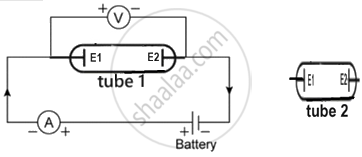
Neglecting internal resistance of the cell use (> or < or =) to compare:
- the resistance in both the cases.
- the voltmeter readings in both the cases.
- the specific resistance in both the cases.
Which of the following correctly defines Potential Difference (V) as one of the three core quantities of Ohm's Law?
What is the nature of the graph obtained when potential difference is plotted against current for an Ohmic conductor?
If the voltage across a conductor is increased while its temperature remains unchanged, what happens to the current flowing through it?
