Advertisements
Advertisements
प्रश्न
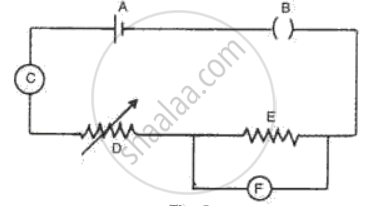
Fig. represents the circuit used for the verification of Ohm's law. Label the parts from A to F. state the function of each.
Advertisements
उत्तर
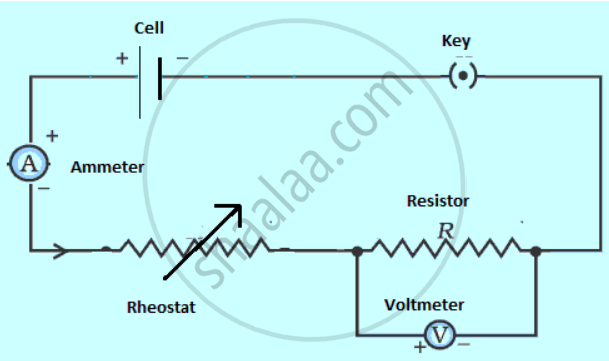
Functions:
(A) Cell- It provides the potential difference in the circuit.
(B) Key- It serves as a switch in the circuit. It supplies or cuts off current as required.
(C) Ammeter- It measures the current in the circuit.
(D) Rheostat- It helps to change the resistance of the circuit without changing its voltage.
(E) Resistor- It provides a constant resistance in the circuit.
(F) Voltmeter- It measure the potential drop across the resistor.
APPEARS IN
संबंधित प्रश्न
Write the SI unit of resistivity
Name the law which is illustrated by the above V−I graph.
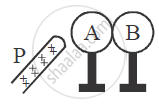
Two metallic spheres A and B kept on insulating stands are in contact with each other. A positively charged rod P is brought near the sphere A as shown in the figure. The two spheres are separated from each other, and the rod P is removed. What will be the nature of charges on spheres A and B?
Define ampere and volt with respect to Ohm’s law.
Draw a neat diagram for the verification of Ohm’s law by voltmeter-ammeter method. By another diagram show the relation between p.d. and current.
Write a short note on superconductors?
Ohm's law deals with the relationship between ______
Why should an ammeter have low resistance?
A resistor is connected in a circuit with a voltage of 12 V and a resistance of 24 Ω. What is the current flowing through the resistor?
Which formula is used with Ohm's Law to help determine power consumption in an electrical circuit?
