Advertisements
Advertisements
प्रश्न
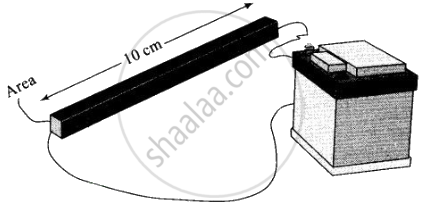
A metal rod of length 10 cm and a rectangular cross-section of 1 cm × `1/2` cm is connected to a battery across opposite faces. The resistance will be ______.
पर्याय
maximum when the battery is connected across 1 cm × `1/2` cm faces.
maximum when the battery is connected across 10 cm × `1/2` cm faces.
maximum when the battery is connected across 10 cm × `1/2` cm faces.
same irrespective of the three faces.
Advertisements
उत्तर
A metal rod of length 10 cm and a rectangular cross-section of 1 cm × `1/2` cm is connected to a battery across opposite faces. The resistance will be maximum when the battery is connected across 1 cm × `1/2` cm faces.
Explanation:
The resistance of a wire depends on various parameters, its area, material (resistivity) and length (length of the rod).
Here, the metallic rod behaves as a wire.
The relationship between resistance and various parameter is given by R = ρl/A.
The resistance of a wire is given by R = `p l/A`
For greater value of R, l must be higher and A should be lower and it is possible only when the battery is connected across 1 cm × `(1/2)` cm (area of corss-section A).
APPEARS IN
संबंधित प्रश्न
What will be the change in the current if the potential difference is kept constant and the resistance of the circuit is made four times?
- It will remain unchanged.
- It will become four times.
- It will become one-fourth.
- It will become half.
Find the resistance of a conductor if 0.24 A current is passing through it and a potential difference of 24 V is applied across it.
The relationship between the potential difference and the current in a conductor is stated in the form of a law.
- Name the law.
- What does the slope of V-I graph for a conductor represent?
- Name the material used for making the connecting wire.
Ohm's law gives a relationship between:
(a) current and resistance
(b) resistance and potential difference
(c) potential difference and electric charge
(d) current and potential difference
How would you connect two resistors in series? Draw a diagram. Calculate the total equivalent resistance.
In the circuit shown below in Fig, calculate the value of x if the equivalent resistance between A and B is 4 Ω.

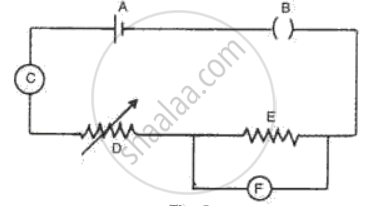
Fig. represents the circuit used for the verification of Ohm's law. Label the parts from A to F. state the function of each.
- Name and state the law which relates the potential difference and current in a conductor.
- What is the necessary condition for a conductor to obey the law named above in part (a) ?
What is meant by the drift speed of free electrons?
State the limitations of Ohm’s law.
The ratio of the potential difference to the current is known as ________.
Write a short note on superconductors?
Obtain the macroscopic form of Ohm’s law from its microscopic form and discuss its limitation.
What is the resistance of a conductor through which a current of 0.5 A flows when a potential difference of 2V is applied across its ends?

Vinita and Ahmed demonstrated a circuit that operates the two headlights and the two sidelights of a car, in their school exhibition. Based on their demonstrated circuit, answer the following questions.
- State what happens when switch A is connected to:
a) Position 2
b) Position 3 - Find the potential difference across each lamp when lit.
- Calculate the current.
a) in each 12 Ω lamp when lit.
b) In each 4 Ω lamp when lit.
OR - Show, with calculations, which type of lamp, 4.0 Ω or 12 Ω, has the higher power.
A current of 3.2 mA flows through a conductor. If charge on an electron is −1.6 × 10⁻¹⁹ coulomb, find the number of electrons that will pass each second through the cross section of that conductor.
Resistance (R) in a conductor is best described as:
Which of the following is an example of a Non-Ohmic material?
