Advertisements
Advertisements
प्रश्न
State Ohm’s law.
What is Ohm’s law?
Advertisements
उत्तर
According to Ohm’s law, at a constant temperature, the steady current ‘I’ flowing through a conductor is directly proportional to the potential difference ‘V’ between the two ends of the conductor.
I ∝ V
V = IR
संबंधित प्रश्न
When a 12 V battery is connected across an unknown resistor, there is a current of 2.5 mA in the circuit. Find the value of the resistance of the resistor.
The relationship between the potential difference and the current in a conductor is stated in the form of a law.
1) Name the law.
2) What does the slope of V-I graph for a conductor represent?
3) Name the material used for making the connecting wire.
What is an Ohmic resistor?
Name the law which is illustrated by the above V−I graph.
Keeping the p.d. constant, the resistance of a circuit is halved. The current will become:
(a) one-fourth
(b) four time
(c) half
(d) double
State Ohm’s law and draw a neat labelled circuit diagram containing a battery, a key, a voltmeter, an ammeter, a rheostat and an unknown resistance to verify it.
A metal sphere is kept on an insulting stands. A negatively charged rod is brought near it, then the sphere is earthed as shown. On removing the earthing, and taking the negatively charged rod away, what will be the nature of charge on the sphere? Give reason for your answer.

Fig. represents the circuit used for the verification of Ohm's law. Label the parts from A to F. state the function of each.
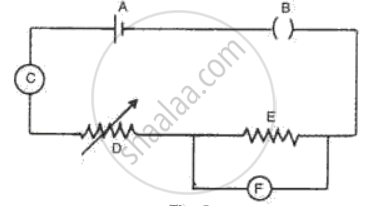
The filament of a bulb takes a current 100 mA when potential difference across it is 0.2 V. When the potential difference across it becomes 1.0 V, the current becomes 400 mA. Calculate the resistance of filament in each case and account for the difference.
State the relation correlating the electric current flowing in a conductor and the voltage applied across it. Also, draw a graph to show this relationship.
State the limitations of Ohm’s law.
Obtain the macroscopic form of Ohm’s law from its microscopic form and discuss its limitation.
The resistance of a nichrome wire at 0°C is 10Ω. If its temperature coefficient of resistivity of nichrome is 0.004/ °C, find its resistance of the wire at boiling point of water. Comment on the result.
Two cells each of 5V are connected in series across an 8Ω resistor and three parallel resistors of 4Ω, 6Ω, and 12Ω. Draw a circuit diagram for the above arrangement. Calculate
- the current drawn from the cell
- current through each resistor
Which of the following is correct for V-I graph of a good conductor?
The unit of specific resistance is ____________.
The slope of voltage (V) versus current (I) is called:

State Ohm’s law? How can it be verified experimentally? Does it hold good under all conditions? Comment.

Calculate the total resistance of the circuit and find the total current in the circuit.
A current of 2amp flowing through a conductor produced 80 joule of heat in 10 sec. The resistance of the conductor is:-
