Advertisements
Advertisements
प्रश्न
An electrical bulb is marked 200V, 100W. Calculate the electrical resistance of its filament. If five such
bulbs are connected in series to a 200V supply, how much current will flow through them?
Advertisements
उत्तर
Voltage V = 200 V, Power P = 100 W
∴ Electrical current = `P/V = 100/200 = 1/2` Amp
∴ Electrical resistance `R = V/I = 200/("I/2") `= 400 Ω
if five bulbs are connected in series to 200V
∴ Total resistance RT = 400 + 400 + 400 + 400 + 400 = 2000Ω
Current flowing thorugh a bulb `I = 200/2000 = 0.1 A `
APPEARS IN
संबंधित प्रश्न
What will be the change in the current if the potential difference is kept constant and the resistance of the circuit is made four times?
- It will remain unchanged.
- It will become four times.
- It will become one-fourth.
- It will become half.
Will current flow more easily through a thick wire or a thin wire of the same material, when connected to the same source? Why?
The relationship between the potential difference and the current in a conductor is stated in the form of a law.
- Name the law.
- What does the slope of V-I graph for a conductor represent?
- Name the material used for making the connecting wire.
What is an Ohmic resistor?
Write the formula of resistivity
In the circuit shown below in Fig, calculate the value of x if the equivalent resistance between A and B is 4 Ω.

Calculate the electric field in a copper wire of cross-sectional area 2.0 mm2 carrying a current of 1 A.
The resistivity of copper = 1.7 × 10⁻⁸ Ω m
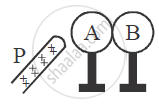
Two metallic spheres A and B kept on insulating stands are in contact with each other. A positively charged rod P is brought near the sphere A as shown in the figure. The two spheres are separated from each other, and the rod P is removed. What will be the nature of charges on spheres A and B?
What is meant by the drift speed of free electrons?
