Advertisements
Advertisements
प्रश्न
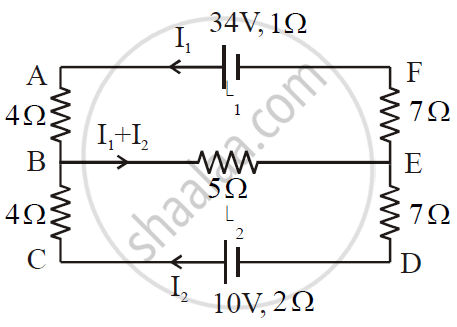
ε1 and ε2 are two batteries having emf of 34V and 10V respectively and internal resistance of 1Ω and 2Ω respectively. They are connected as shown in the figure below. Using Kirchhoff’s Laws of electrical networks, calculate the currents I1 and I2.
Advertisements
उत्तर
By Kirchoff’s law of electrical networks consider closed loop ABEFA
`:. -4I_1 - 5(I_2 + I_2 ) - 7I_1 - I_1 + 34= 0`
`:. -4I_1 - 5I_1 - 5I_2 - 7I_1 - I_1 = -34`
`:. -17I_1 - 5I_2 = -34`
`:. 17I_1 + 5I_2 = 34` .....(1)
Consider closed loop BCDEB,
`4I_2 - 10 + 2I_2 + 7I_2 + 5(I_1 + I_2) = 0`
`:. 4I_2 + 2I_2 + 7I_2 + 5I_1 + 5I_2 = 10`
`18I_2 + 5I_1 = 10` ....(2)
Mutiply equation (1) by 5 and equation (2) by 17 and Substract

∴ `I_1 = 2A`
APPEARS IN
संबंधित प्रश्न
Use Kirchhoff's rules to obtain conditions for the balance condition in a Wheatstone bridge.
Given n resistors each of resistance R, how will you combine them to get the (i) maximum (ii) minimum effective resistance? What is the ratio of the maximum to minimum resistance?
State Kirchhoff's rules and explain on what basis they are justified.
In the given circuit, assuming point A to be at zero potential, use Kirchhoff’s rules to determine the potential at point B.

While measuring the length of the rod by vernier callipers, the reading on the main scale is 6.4 cm and the eight divisions on vernier is in line with marking on the main scale division. If the least count of callipers is 0.01 and zero error - 0.04 cm, the length of the rod is ______.
State the two Kirchhoff’s rules used in the analysis of electric circuits and explain them.
Derive the equation of the balanced state in a Wheatstone bridge using Kirchhoff’s laws.
What is potential difference?
Which sign convention is usually used for current leaving a junction?
While moving in the direction of current through a resistor, how is the potential change treated?
