Advertisements
Advertisements
प्रश्न
State Kirchhoff's rules and explain on what basis they are justified.
Advertisements
उत्तर
Kirchhoff’s first rule (Junction rule): The algebraic sum of the currents meeting at a point in an electrical circuit is always zero.
\[\sum_{} I = 0\]
This law is justified on the basis of law of conservation of charge.
Kirchhoff’s second law (Loop rule): In a closed loop, the algebraic sum of the emfs is equal to the algebraic sum of the products of the resistances and the current flowing through them.
\[\sum_{} I = 0\]
This law is justified on the basis of law of conservation of energy.
APPEARS IN
संबंधित प्रश्न
State the two Kirchhoff’s rules used in electric networks. How are there rules justified?
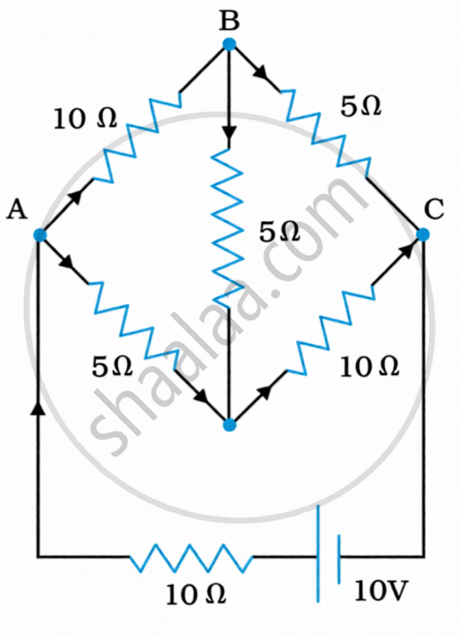
Determine the current in each branch of the network shown in figure.
Consider the following two statements:-
(A) Kirchhoff's junction law follows from conservation of charge.
(B) Kirchhoff's loop law follows from conservative nature of electric field.
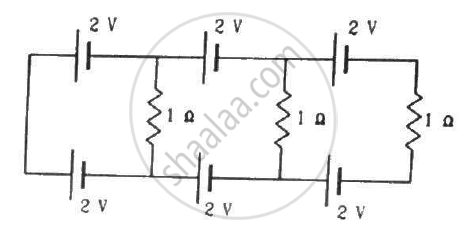
Find the circuit in the three resistors shown in the figure.
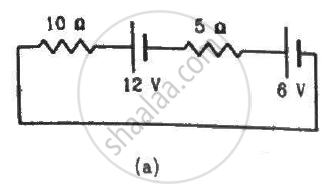
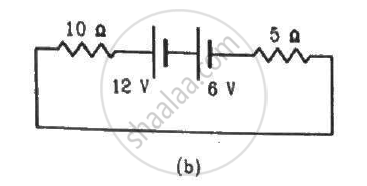
Consider the circuit shown in the figure. Find (a) the current in the circuit (b) the potential drop across the 5 Ω resistor (c) the potential drop across the 10 Ω resistor (d) Answer the parts (a), (b) and (c) with reference to the figure.
Solve the following question.
Using Kirchhoff’s rules, calculate the current through the 40 Ω and 20 Ω resistors in the following circuit.
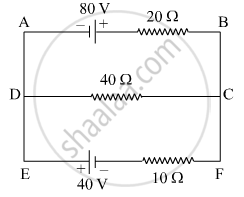
State Kirchhoff’s current rule.
Explain the determination of unknown resistance using meter bridge.
How the emf of two cells are compared using potentiometer?
The e.m.f of The battery in a thermocouple is doubled. The rate of heat generated at one of the junction will.
What is the advantage of using thick metallic strips to join wires in a potentiometer?
Power P is to be delivered to a device via transmission cables having resistance RC. If V is the voltage across R and I the current through it, find the power wasted and how can it be reduced.
State the two Kirchhoff’s rules used in the analysis of electric circuits and explain them.
A constant voltage of 50 V is maintained between the points A and B of the circuit shown in the figure. The current through the branch CD of the circuit is:
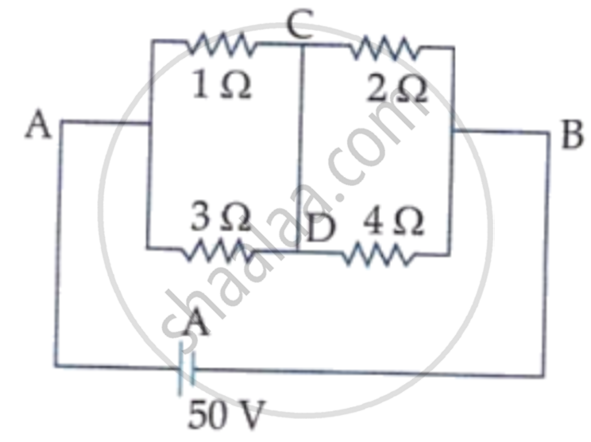
Which two basic physical principles form the basis of Kirchhoff's laws?
Which mathematical form represents Kirchhoff's Current Law using an algebraic sum of currents?
Which term is defined as the rate of flow of charge through a conductor?
What is potential difference?
In a closed loop containing cells and resistors, what equals the total potential drop across the resistors?
