Advertisements
Advertisements
प्रश्न
State Kirchhoff's rules and explain on what basis they are justified.
Advertisements
उत्तर
Kirchhoff’s first rule (Junction rule): The algebraic sum of the currents meeting at a point in an electrical circuit is always zero.
\[\sum_{} I = 0\]
This law is justified on the basis of law of conservation of charge.
Kirchhoff’s second law (Loop rule): In a closed loop, the algebraic sum of the emfs is equal to the algebraic sum of the products of the resistances and the current flowing through them.
\[\sum_{} I = 0\]
This law is justified on the basis of law of conservation of energy.
APPEARS IN
संबंधित प्रश्न
State the two Kirchhoff’s rules used in electric networks. How are there rules justified?
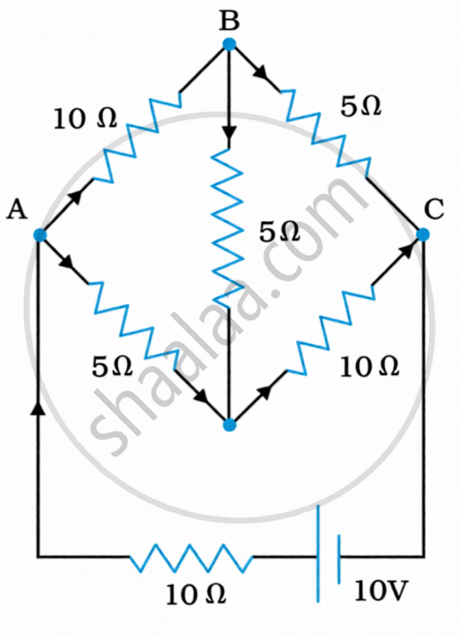
Determine the current in each branch of the network shown in figure.
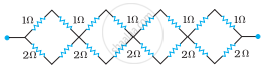
Determine the equivalent resistance of networks shown in Fig.
Calculate the value of the resistance R in the circuit shown in the figure so that the current in the circuit is 0.2 A. What would b the potential difference between points B and E?

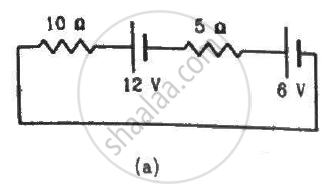
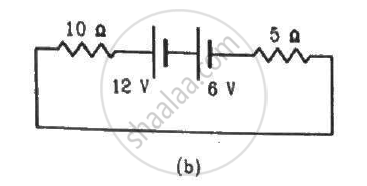
Consider the circuit shown in the figure. Find (a) the current in the circuit (b) the potential drop across the 5 Ω resistor (c) the potential drop across the 10 Ω resistor (d) Answer the parts (a), (b) and (c) with reference to the figure.
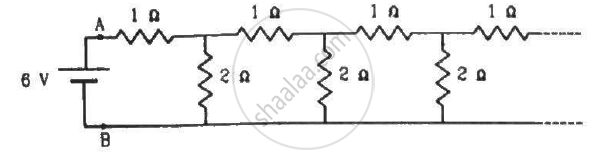
An infinite ladder is constructed with 1 Ω and 2 Ω resistors, as shown in the figure. (a) Find the effective resistance between the points A and B. (b) Find the current that passes through the 2 Ω resistor nearest to the battery.
Solve the following question.
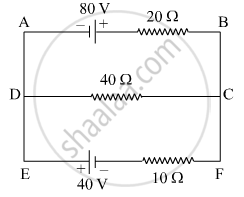
Using Kirchhoff’s rules, calculate the current through the 40 Ω and 20 Ω resistors in the following circuit.
A copper wire of 10-6 m2 area of cross-section, carries a current of 2 A. If the number of electrons per cubic meter is 8 × 1028, calculate the current density and average drift velocity.
Two cell of 1.25 V and 0.75 V are connected parallel. The effective voltage will be:-
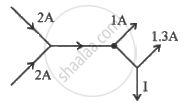
The figure below shows current in a part of electric circuit. The current I is ______.
Kirchhoff s second law is based on the law of conservation of ______
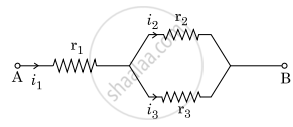
Three resistors having resistances r1, r2 and r3 are connected as shown in the given circuit. The ratio `"i"_3/"i"_1` of currents in terms of resistances used in the circuit is :
Power P is to be delivered to a device via transmission cables having resistance RC. If V is the voltage across R and I the current through it, find the power wasted and how can it be reduced.
Derive the equation of the balanced state in a Wheatstone bridge using Kirchhoff’s laws.
A 6-volt battery is connected to the terminals of a three-metre-long wire of uniform thickness and resistance of 100 ohms. The difference of potential between two points on the wire separated by a distance of 50 cm will be ______.
What is a branch?
What is a loop?
Which term is defined as the rate of flow of charge through a conductor?
If currents \[I_1\] and \[I_2\] enter a junction and currents \[I_3\] and \[I_4\] leave it, which equation follows from Kirchhoff's First Law?
