Advertisements
Advertisements
Question
State Kirchhoff's rules and explain on what basis they are justified.
Advertisements
Solution
Kirchhoff’s first rule (Junction rule): The algebraic sum of the currents meeting at a point in an electrical circuit is always zero.
\[\sum_{} I = 0\]
This law is justified on the basis of law of conservation of charge.
Kirchhoff’s second law (Loop rule): In a closed loop, the algebraic sum of the emfs is equal to the algebraic sum of the products of the resistances and the current flowing through them.
\[\sum_{} I = 0\]
This law is justified on the basis of law of conservation of energy.
APPEARS IN
RELATED QUESTIONS
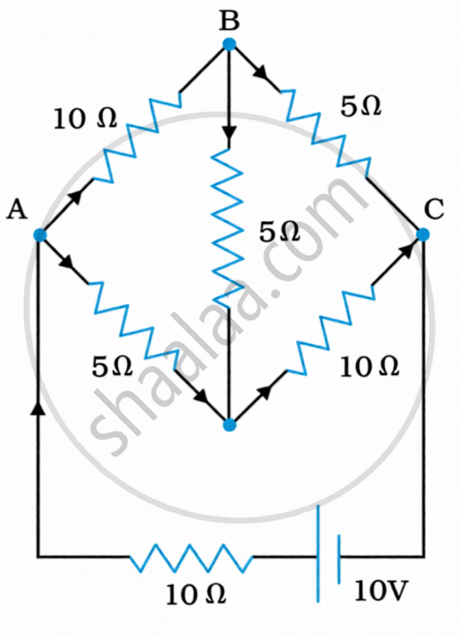
Determine the current in each branch of the network shown in figure.
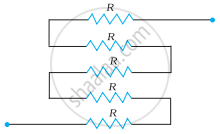
Given n resistors each of resistance R, how will you combine them to get the (i) maximum (ii) minimum effective resistance? What is the ratio of the maximum to minimum resistance?
Determine the equivalent resistance of networks shown in Fig.
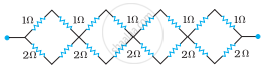
Determine the equivalent resistance of networks shown in Fig.
State Kirchhoff's rules for an electric network. Using Kirchhoff's rules, obtain the balance condition in terms of the resistances of four arms of Wheatstone bridge.
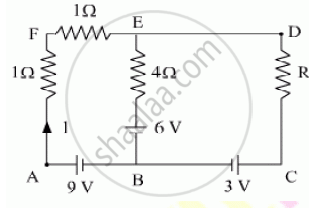
Using Kirchhoff’s rules determine the value of unknown resistance R in the circuit so that no current flows through 4 Ω resistance. Also find the potential difference between A and D.
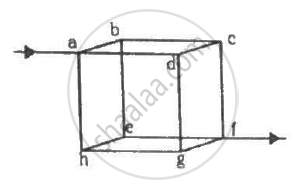
Twelve wires, each of equal resistance r, are joined to form a cube, as shown in the figure. Find the equivalent resistance between the diagonally-opposite points a and f.
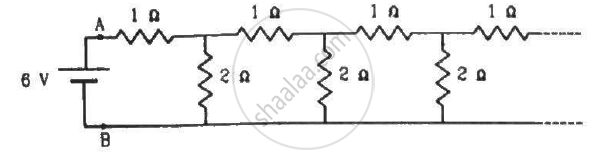
An infinite ladder is constructed with 1 Ω and 2 Ω resistors, as shown in the figure. (a) Find the effective resistance between the points A and B. (b) Find the current that passes through the 2 Ω resistor nearest to the battery.
In the circuit shown in the figure below, E1 and E2 are two cells having emfs 2 V and 3 V respectively, and negligible internal resistance. Applying Kirchhoff’s laws of electrical networks, find the values of currents l1 and I2.

State and explain Kirchhoff’s rules.
Obtain the condition for bridge balance in Wheatstone’s bridge.
Assertion: Kirchhoff’s junction rule follows from conservation of charge.
Reason: Kirchhoff’s loop rule follows from conservation of momentum.
Two cell of 1.25 V and 0.75 V are connected parallel. The effective voltage will be:-
Kirchhoff’s junction rule is a reflection of ______.
- conservation of current density vector.
- conservation of charge.
- the fact that the momentum with which a charged particle approaches a junction is unchanged (as a vector) as the charged particle leaves the junction.
- the fact that there is no accumulation of charges at a junction.
The circuit in figure shows two cells connected in opposition to each other. Cell E1 is of emf 6V and internal resistance 2Ω; the cell E2 is of emf 4V and internal resistance 8Ω. Find the potential difference between the points A and B.
Which pair of equations expresses the loop relationship for cells and resistors?
What is a junction or node?
What is a loop?
Which algebraic form is equivalent to \[I_1+I_2=I_3+I_4\]?
