Advertisements
Advertisements
Question
The figure below shows two batteries, E1 and E2, having emfs of 18V and 10V and internal resistances of 1 Ω and 2 Ω, respectively. W1, W2 and W3 are uniform metallic wires AC, FD and BE having resistances of 8 Ω, 6 Ω and 10 Ω respectively. B and E are midpoints of the wires W1 and W2. Using Kirchhoff's laws of electrical circuits, calculate the current flowing in the wire W3:

Advertisements
Solution
Since B and E are the mid-points of AC and FD respectively, so resistance between AB, BC, DE and EF will be 4 Ω, 4 Ω, 3 Ω and 3 Ω respectively as shown in the diagram.

Using Kirchhoff's law in the closed-loop ABEFA, we have:
4 I1 + 10 I1 + 10 I2 + 3 I1 + 1 I1 = 18
18 I1 + 10 I2 = 18
9 I1 + 5 I2 = 9 ...(i)
For the closed-loop BEDCB, we have.
4 I2 + 10 I1 +10 I2 + 3 I2 + 2I2 = 10
10 I1 + 19 I2 = 10 ...(ii)
Solving equation (i) and (ii),
9 I1 + 5 I2 = 9 ...(i) × 10
10 I1 + 19 I2 = 10 ...(ii) × 9
90 I1 + 50 I2 = 90
90 I1 + 171 I2 = 90
(-) (-) (-)
`=> -121 I_2 = 0`
`=>` I2 = 0
Putting I2 = 0 in equation (i),
9 I1 + 5 × 0 = 9
9 I1 = 9 or I1 = 1A
∴ I1 = 1A, I2 = 0
and I3 = I1 + I2
= 1A
APPEARS IN
RELATED QUESTIONS
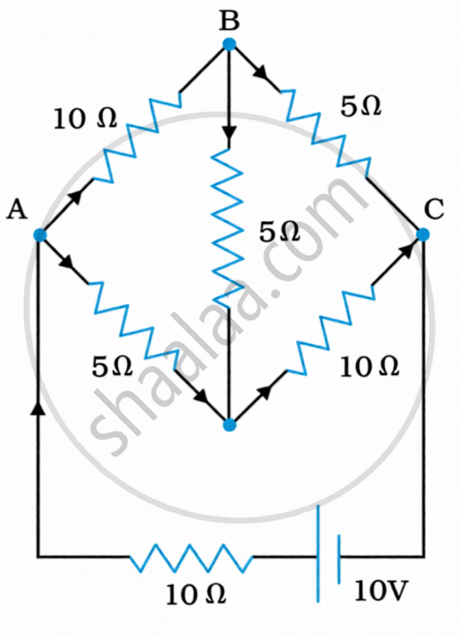
Determine the current in each branch of the network shown in figure.
Given the resistances of 1 Ω, 2 Ω, 3 Ω, how will be combine them to get an equivalent resistance of (11/3) Ω?
State Kirchhoff's rules for an electric network. Using Kirchhoff's rules, obtain the balance condition in terms of the resistances of four arms of Wheatstone bridge.
State and explain Kirchhoff’s rules.
The Kirchhoff's second law (ΣiR = ΣE), where the symbols have their usual meanings, is based on ______.
Two cell of 1.25 V and 0.75 V are connected parallel. The effective voltage will be:-
Kirchhoff’s junction rule is a reflection of ______.
- conservation of current density vector.
- conservation of charge.
- the fact that the momentum with which a charged particle approaches a junction is unchanged (as a vector) as the charged particle leaves the junction.
- the fact that there is no accumulation of charges at a junction.
What is the advantage of using thick metallic strips to join wires in a potentiometer?
Derive the equation of the balanced state in a Wheatstone bridge using Kirchhoff’s laws.
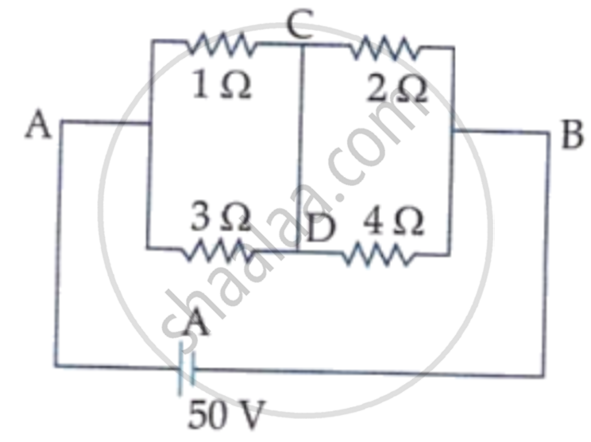
A constant voltage of 50 V is maintained between the points A and B of the circuit shown in the figure. The current through the branch CD of the circuit is: