Advertisements
Advertisements
Question
Given the resistances of 1 Ω, 2 Ω, 3 Ω, how will be combine them to get an equivalent resistance of (6/11) Ω?
Advertisements
Solution
Equivalent resistance, R' = `6/11` Ω
Consider the series combination of the resistors, as shown in the given circuit.
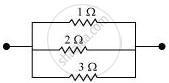
Equivalent resistance of the circuit is given by,
R' = `(1 xx 2 xx 3)/(1 xx 2 + 2 xx 3 + 1 xx 3)`
= `6/11` Ω
APPEARS IN
RELATED QUESTIONS
Kirchhoff's voltage law and current law are respectively in accordance with the conservation of .................................. .
- charge and momentum
- charge and energy
- energy and charge
- energy and momentum
Use Kirchhoff's rules to obtain conditions for the balance condition in a Wheatstone bridge.
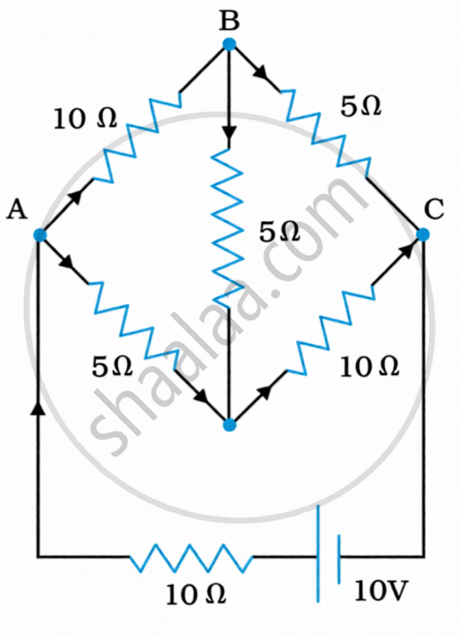
Determine the current in each branch of the network shown in figure.
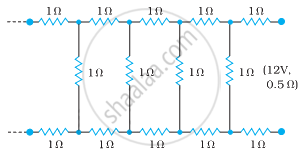
Determine the current drawn from a 12 V supply with internal resistance 0.5 Ω by the infinite network shown in the figure. Each resistor has 1 Ω resistance.
Given the resistances of 1 Ω, 2 Ω, 3 Ω, how will be combine them to get an equivalent resistance of (11/3) Ω?
State Kirchhoff's rules for an electric network. Using Kirchhoff's rules, obtain the balance condition in terms of the resistances of four arms of Wheatstone bridge.
Calculate the value of the resistance R in the circuit shown in the figure so that the current in the circuit is 0.2 A. What would b the potential difference between points B and E?

In the given circuit, assuming point A to be at zero potential, use Kirchhoff’s rules to determine the potential at point B.

Consider the following two statements:-
(A) Kirchhoff's junction law follows from conservation of charge.
(B) Kirchhoff's loop law follows from conservative nature of electric field.
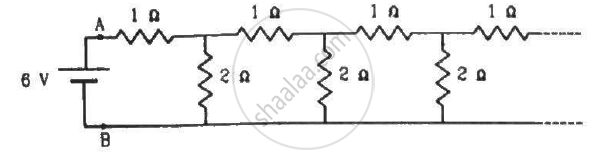
An infinite ladder is constructed with 1 Ω and 2 Ω resistors, as shown in the figure. (a) Find the effective resistance between the points A and B. (b) Find the current that passes through the 2 Ω resistor nearest to the battery.
State Kirchhoff’s current rule.
State Kirchhoff ’s voltage rule.
State the principle of potentiometer.
Obtain the condition for bridge balance in Wheatstone’s bridge.
How the emf of two cells are compared using potentiometer?
A copper wire of 10-6 m2 area of cross-section, carries a current of 2 A. If the number of electrons per cubic meter is 8 × 1028, calculate the current density and average drift velocity.
A potentiometer wire has a length of 4 m and resistance of 20 Ω. It is connected in series with resistance of 2980 Ω and a cell of emf 4 V. Calculate the potential along the wire.
In a potentiometer arrangement, a cell of emf 1.25 V gives a balance point at 35 cm length of the wire. If the cell is replaced by another cell and the balance point shifts to 63 cm, what is the emf of the second cell?
Kirchhoff’s second law is a consequence of law of conservation of ______.
The e.m.f of The battery in a thermocouple is doubled. The rate of heat generated at one of the junction will.
Kirchhoff s second law is based on the law of conservation of ______
In a meter bridge the point D is a neutral point (Figure).
- The meter bridge can have no other neutral point for this set of resistances.
- When the jockey contacts a point on meter wire left of D, current flows to B from the wire.
- When the jockey contacts a point on the meter wire to the right of D, current flows from B to the wire through galvanometer.
- When R is increased, the neutral point shifts to left.
Two cells of voltage 10V and 2V and internal resistances 10Ω and 5Ω respectively, are connected in parallel with the positive end of 10V battery connected to negative pole of 2V battery (Figure). Find the effective voltage and effective resistance of the combination.

State the two Kirchhoff’s rules used in the analysis of electric circuits and explain them.
Who gave Kirchhoff's laws?
What does Kirchhoff's Voltage Law state for a closed loop?
Which term is defined as the rate of flow of charge through a conductor?
What is potential difference?
Which algebraic form is equivalent to \[I_1+I_2=I_3+I_4\]?
In a closed loop containing cells and resistors, what equals the total potential drop across the resistors?
Which sign convention is usually used for current entering a junction?
While moving opposite to the direction of current through a resistor, how is the potential change treated?
