Advertisements
Advertisements
Question
In the circuit shown in Figure below, E1 and E2 are batteries having emfs of 25V and 26V. They have an internal resistance of 1 Ω and 5 Ω respectively. Applying Kirchhoff’s laws of electrical networks, calculate the currents I1 and I2.

Advertisements
Solution
Applying Kirchhoff's voltage law to loop ABCDEF, we get
2(I1 + I2) + 3I2 - 26 + 5I2 = 0
or 2I1 + 2I2 + 3I2 + 5I2 = 26
or I1 + 5I2 = 13 ...(i)
Now, applying Kirchhoff’s voltage law to loop HJBCDEG.
2(I1 + I2) + 4I1 + I1 - 25 = 0
or 2I1 + 2I2 + 5I1 = 25
or 7I1 + 2I2 = 25 ...(ii)
Equation (i) × 2 - equation (ii) × 5
2I1 + 10I2 = 26
35I1 + 10I2 = 125
- - -
- 33I1 = - 99
I1 = 3
From equation (i)
3 + 5I2 = 13
or I2 = 2
Hence I1 = 3 A
I2 = 2 A.
APPEARS IN
RELATED QUESTIONS
Given the resistances of 1 Ω, 2 Ω, 3 Ω, how will be combine them to get an equivalent resistance of (6/11) Ω?
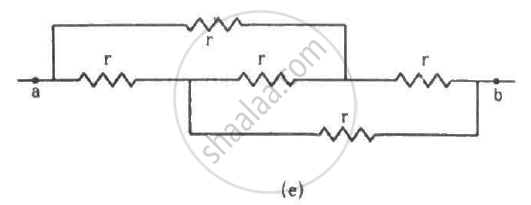
Find the equivalent resistances of the networks shown in the figure between the points a and b.
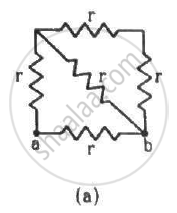
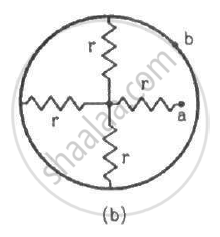
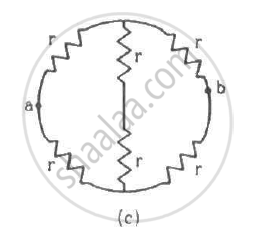
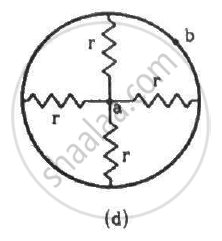
Obtain the condition for bridge balance in Wheatstone’s bridge.
In a potentiometer arrangement, a cell of emf 1.25 V gives a balance point at 35 cm length of the wire. If the cell is replaced by another cell and the balance point shifts to 63 cm, what is the emf of the second cell?
Kirchhoff’s second law is a consequence of law of conservation of ______.
Two cell of 1.25 V and 0.75 V are connected parallel. The effective voltage will be:-
State the two Kirchhoff’s rules used in the analysis of electric circuits and explain them.
Who gave Kirchhoff's laws?
What is potential difference?
After a charge completes one full loop and returns to its starting point, what is the net change in potential?
