Advertisements
Advertisements
प्रश्न
In the circuit shown in Figure below, E1 and E2 are batteries having emfs of 25V and 26V. They have an internal resistance of 1 Ω and 5 Ω respectively. Applying Kirchhoff’s laws of electrical networks, calculate the currents I1 and I2.

Advertisements
उत्तर
Applying Kirchhoff's voltage law to loop ABCDEF, we get
2(I1 + I2) + 3I2 - 26 + 5I2 = 0
or 2I1 + 2I2 + 3I2 + 5I2 = 26
or I1 + 5I2 = 13 ...(i)
Now, applying Kirchhoff’s voltage law to loop HJBCDEG.
2(I1 + I2) + 4I1 + I1 - 25 = 0
or 2I1 + 2I2 + 5I1 = 25
or 7I1 + 2I2 = 25 ...(ii)
Equation (i) × 2 - equation (ii) × 5
2I1 + 10I2 = 26
35I1 + 10I2 = 125
- - -
- 33I1 = - 99
I1 = 3
From equation (i)
3 + 5I2 = 13
or I2 = 2
Hence I1 = 3 A
I2 = 2 A.
APPEARS IN
संबंधित प्रश्न
Given n resistors each of resistance R, how will you combine them to get the (i) maximum (ii) minimum effective resistance? What is the ratio of the maximum to minimum resistance?
Calculate the value of the resistance R in the circuit shown in the figure so that the current in the circuit is 0.2 A. What would b the potential difference between points A and B?

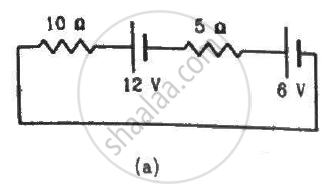
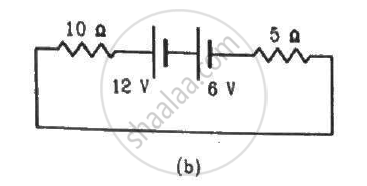
Consider the circuit shown in the figure. Find (a) the current in the circuit (b) the potential drop across the 5 Ω resistor (c) the potential drop across the 10 Ω resistor (d) Answer the parts (a), (b) and (c) with reference to the figure.
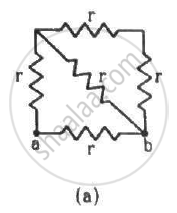
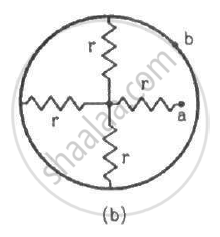
Find the equivalent resistances of the networks shown in the figure between the points a and b.
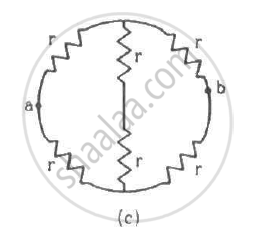
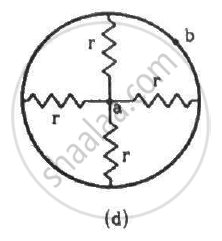
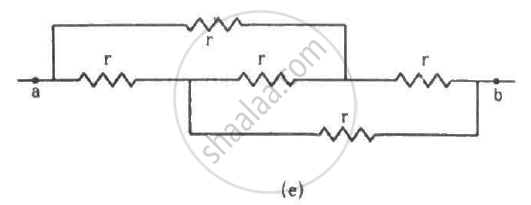
A capacitor of capacitance 8.0 μF is connected to a battery of emf 6.0 V through a resistance of 24 Ω. Find the current in the circuit (a) just after the connections are made and (b) one time constant after the connections are made.
In the circuit shown in the figure below, E1 and E2 are two cells having emfs 2 V and 3 V respectively, and negligible internal resistance. Applying Kirchhoff’s laws of electrical networks, find the values of currents l1 and I2.

State Kirchhoff ’s voltage rule.
State the principle of potentiometer.
Derive the equation of the balanced state in a Wheatstone bridge using Kirchhoff’s laws.
What is Kirchhoff's Voltage Law also called?
