Advertisements
Advertisements
प्रश्न
State Kirchhoff’s current rule.
Advertisements
उत्तर
- Kirchhoff’s current rule states that the algebraic sum of the currents at any junction of a circuit is zero.
i.e `Σ_"junction"` i = 0 - It is a statement of conservation of electric charge.
APPEARS IN
संबंधित प्रश्न
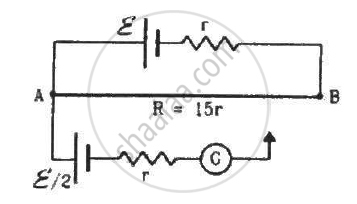
Consider the potentiometer circuit as arranged in the figure. The potentiometer wire is 600 cm long. (a) At what distance from the point A should the jockey touch the wire to get zero deflection in the galvanometer? (b) If the jockey touches the wire at a distance of 560 cm from A, what will be the current in the galvanometer?
A capacitor of capacitance 8.0 μF is connected to a battery of emf 6.0 V through a resistance of 24 Ω. Find the current in the circuit (a) just after the connections are made and (b) one time constant after the connections are made.
Obtain the condition for bridge balance in Wheatstone’s bridge.
What is the advantage of using thick metallic strips to join wires in a potentiometer?
A 6-volt battery is connected to the terminals of a three-metre-long wire of uniform thickness and resistance of 100 ohms. The difference of potential between two points on the wire separated by a distance of 50 cm will be ______.
At any junction, what does Kirchhoff's Current Law state?
What is Kirchhoff's Voltage Law also called?
What is a junction or node?
Which algebraic form is equivalent to \[I_1+I_2=I_3+I_4\]?
