Advertisements
Advertisements
प्रश्न
Derive the equation of the balanced state in a Wheatstone bridge using Kirchhoff’s laws.
Advertisements
उत्तर

In this case, Kirchhoff’s junction rule applied to junctions D and B (see the figure) immediately gives us the relations I1 = I3 and I2 = I4. Next, we apply Kirchhoff’s loop rule to closed loops ADBA and CBDC.
The first loop gives
–I1R1 + 0 + I2R1 = 0 ...(Ig = 0)
And the second loop gives, upon using I3 = I1, I4 = I2
I2R4 + 0 – I1R3 = 0
From the equation, we obtain,
`I_1/I_2 = R_2/R_1`
Whereas from the equation, we obtain,
`I_1/I_2 = R_4/R_3`
Hence, we obtain the condition
`R_2/R_1 = R_4/R_3`
This last equation relating the four resistors is called the balance condition for the galvanometer to give zero or null deflection.
The Wheatstone bridge and its balance condition provide a practical method for the determination of unknown resistance. Let us suppose we have an unknown resistance, which we insert in the fourth arm; R4 is thus not known. Keeping known resistances R1 and R2 in the first and second arm of the bridge, we go on varying R3 till the galvanometer shows a null deflection. The bridge then is balanced, and from the balance condition the value of the unknown resistance R4 is given by, R4 = `R_3 R_2/R_1`
APPEARS IN
संबंधित प्रश्न
State the two Kirchhoff’s rules used in electric networks. How are there rules justified?
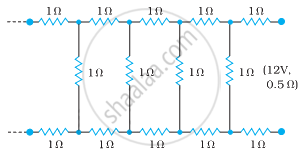
Determine the current drawn from a 12 V supply with internal resistance 0.5 Ω by the infinite network shown in the figure. Each resistor has 1 Ω resistance.
Given the resistances of 1 Ω, 2 Ω, 3 Ω, how will be combine them to get an equivalent resistance of (6/11) Ω?
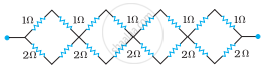
Determine the equivalent resistance of networks shown in Fig.
State Kirchhoff's rules for an electric network. Using Kirchhoff's rules, obtain the balance condition in terms of the resistances of four arms of Wheatstone bridge.
Calculate the value of the resistance R in the circuit shown in the figure so that the current in the circuit is 0.2 A. What would b the potential difference between points A and B?

In the given circuit, assuming point A to be at zero potential, use Kirchhoff’s rules to determine the potential at point B.

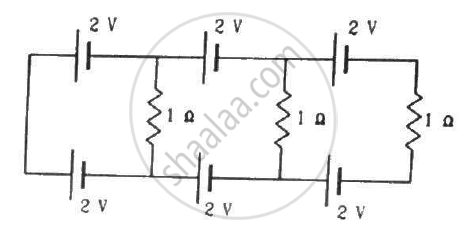
Find the circuit in the three resistors shown in the figure.
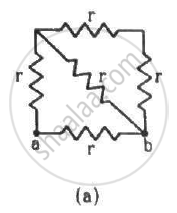
Find the equivalent resistances of the networks shown in the figure between the points a and b.
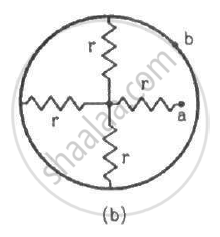
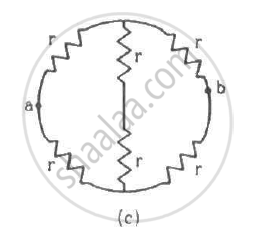
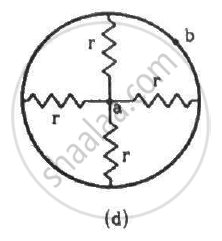
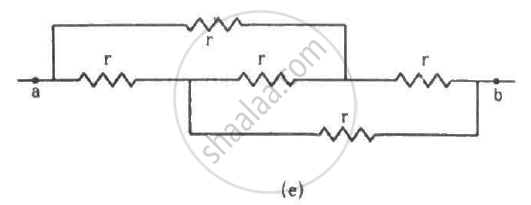
Twelve wires each having a resistance of 3 Ω are connected to form a cubical network. A battery of 10 V and negligible internal resistance is connected across the diagonally opposite corners of this network. Determine its equivalent resistance and the current along each edge of the cube.
Obtain the condition for bridge balance in Wheatstone’s bridge.
A copper wire of 10-6 m2 area of cross-section, carries a current of 2 A. If the number of electrons per cubic meter is 8 × 1028, calculate the current density and average drift velocity.
The value of current in the 6Ω resistance is ______.

In the circuit shown in Figure below, E1 and E2 are batteries having emfs of 25V and 26V. They have an internal resistance of 1 Ω and 5 Ω respectively. Applying Kirchhoff’s laws of electrical networks, calculate the currents I1 and I2.

At any junction, what does Kirchhoff's Current Law state?
What does Kirchhoff's Voltage Law state for a closed loop?
Which term is defined as the rate of flow of charge through a conductor?
Which sign convention is usually used for current entering a junction?
What is the sign of the emf when moving from the negative terminal to the positive terminal of a cell?
