Advertisements
Advertisements
प्रश्न
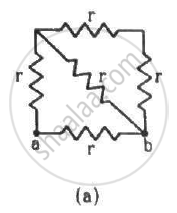
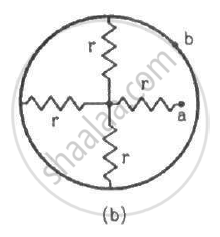
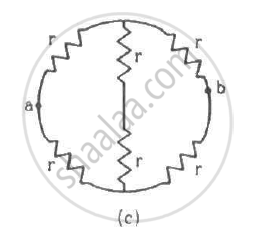
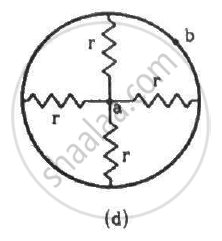
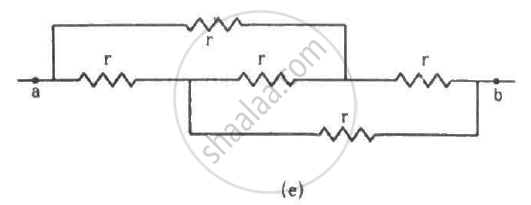
Find the equivalent resistances of the networks shown in the figure between the points a and b.
Advertisements
उत्तर
(a) The circuit can be simplified stepwise, as shown below.
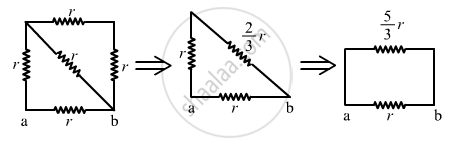
The effective resistance between the points a and b,
\[R_{eff} = \frac{\frac{5r}{3} \times r}{\frac{5r}{3} + r} = \frac{5r}{8}\]
(b) The circuit can be simplified, as shown below.
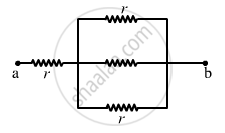
The effective resistance between the points a and b,
\[R_{eff} = \left( \frac{r}{3} \right) + r = \frac{4r}{3}\]
(c)
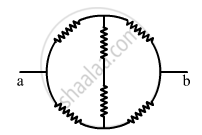
From the figure, it can be seen that axbya is a balanced Wheatstone bridge. The resistors in branch xy will, thus, become ineffective. The circuit can be simplified as under
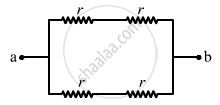
The effective resistance between the points a and b,
\[R_{eff} = \left( \frac{2r \times 2r}{2r + 2r} \right) = r\]
(d) The circuit can be simplified as shown below.
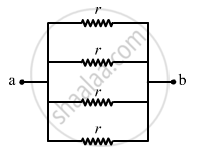
The effective resistance between the points a and b,
\[R_{eff} = \frac{r}{4}\]
(e) The circuit can be redrawn as shown below.
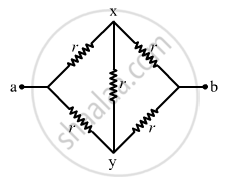
Now, we can see that the circuit is a balanced Wheatstone bridge. So, the branch xy will become ineffective. Thus, the simplified circuit will become as shown below.
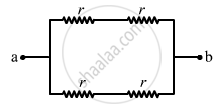
The effective resistance between the points a and b,
\[R_{eff} = \left( \frac{2r \times 2r}{2r + 2r} \right) = r\]
APPEARS IN
संबंधित प्रश्न
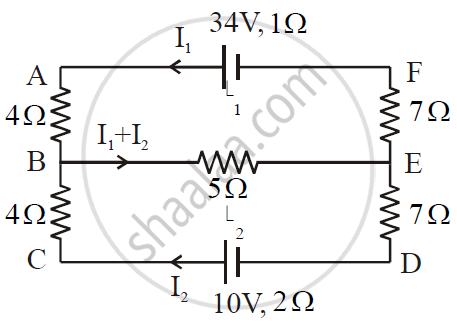
ε1 and ε2 are two batteries having emf of 34V and 10V respectively and internal resistance of 1Ω and 2Ω respectively. They are connected as shown in the figure below. Using Kirchhoff’s Laws of electrical networks, calculate the currents I1 and I2.
State Kirchhoff's rules and explain on what basis they are justified.
Given the resistances of 1 Ω, 2 Ω, 3 Ω, how will be combine them to get an equivalent resistance of 6 Ω?
Given the resistances of 1 Ω, 2 Ω, 3 Ω, how will be combine them to get an equivalent resistance of (6/11) Ω?
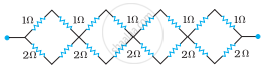
Determine the equivalent resistance of networks shown in Fig.
Calculate the value of the resistance R in the circuit shown in the figure so that the current in the circuit is 0.2 A. What would b the potential difference between points A and B?

In the given circuit, assuming point A to be at zero potential, use Kirchhoff’s rules to determine the potential at point B.

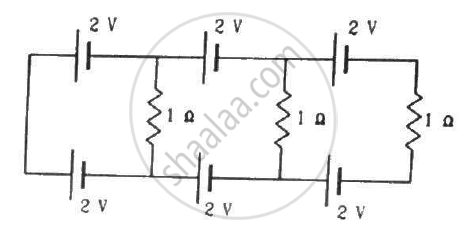
Find the circuit in the three resistors shown in the figure.
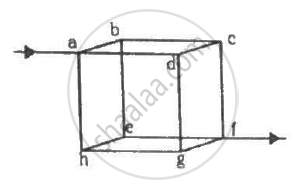
Twelve wires, each of equal resistance r, are joined to form a cube, as shown in the figure. Find the equivalent resistance between the diagonally-opposite points a and f.
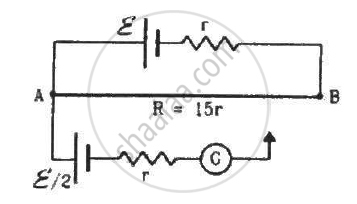
Consider the potentiometer circuit as arranged in the figure. The potentiometer wire is 600 cm long. (a) At what distance from the point A should the jockey touch the wire to get zero deflection in the galvanometer? (b) If the jockey touches the wire at a distance of 560 cm from A, what will be the current in the galvanometer?
On which conservation principle is Kirchoff's Second Law of electrical networks based?
State Kirchhoff’s current rule.
State the principle of potentiometer.
State and explain Kirchhoff’s rules.
Explain the determination of unknown resistance using meter bridge.
Lightning is a very good example of a natural current. In typical lightning, there is 109 J energy transfer across the potential difference of 5 × 10⁷ V during a time interval of 0.2 s. Using this information, estimate the following quantities:
- the total amount of charge transferred between cloud and ground
- the current in the lightning bolt
- the power delivered in 0.2 s.

A potentiometer wire has a length of 4 m and resistance of 20 Ω. It is connected in series with resistance of 2980 Ω and a cell of emf 4 V. Calculate the potential along the wire.
The instrument for the accurate measurement of the e.m.f of a cell is ______.
Assertion: Kirchhoff’s junction rule follows from conservation of charge.
Reason: Kirchhoff’s loop rule follows from conservation of momentum.
Why are alloys used for making standard resistance coils?
Power P is to be delivered to a device via transmission cables having resistance RC. If V is the voltage across R and I the current through it, find the power wasted and how can it be reduced.
Derive the equation of the balanced state in a Wheatstone bridge using Kirchhoff’s laws.
A 6-volt battery is connected to the terminals of a three-metre-long wire of uniform thickness and resistance of 100 ohms. The difference of potential between two points on the wire separated by a distance of 50 cm will be ______.
Which two basic physical principles form the basis of Kirchhoff's laws?
Who gave Kirchhoff's laws?
What is Kirchhoff's Current Law also called?
At any junction, what does Kirchhoff's Current Law state?
What is a branch?
Which term is defined as the rate of flow of charge through a conductor?
What is emf?
Why must the amount of charge entering a junction per second equal the amount leaving when current is steady?
If currents \[I_1\] and \[I_2\] enter a junction and currents \[I_3\] and \[I_4\] leave it, which equation follows from Kirchhoff's First Law?
Which algebraic form is equivalent to \[I_1+I_2=I_3+I_4\]?
What is the sign of the emf when moving from the negative terminal to the positive terminal of a cell?
How are Kirchhoff's laws used in analysing a general network with several unknown branch currents?
