Advertisements
Advertisements
प्रश्न
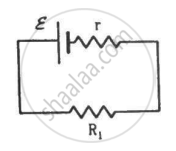
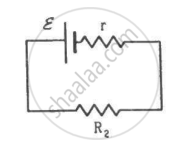
Two unequal resistances, R1 and R2, are connected across two identical batteries of emf ε and internal resistance r (see the figure). Can the thermal energies developed in R1 and R2 be equal in a given time? If yes, what will be the condition?
Advertisements
उत्तर
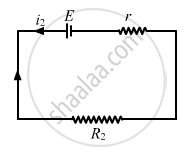
For the given time t, let the currents passing through the resistance R1 and R2 be i1 and i2, respectively.
Applying Kirchoff's Voltage Law to circuit-1, we get:-
\[\epsilon - i_1 r - i_1 R_1 = 0\]
\[ \Rightarrow i_1 = \frac{\epsilon}{r + R_1}\]
Similarly, the current in the other circuit,
\[i_2 = \frac{\epsilon}{r + R_2}\]
The thermal energies through the resistances are given by
\[i_1^2 R_1 t = i_2^2 R_2 t\]
\[ \left( \frac{\epsilon}{r + R_1} \right)^2 R_1 t = \left( \frac{\epsilon}{r + R_2} \right)^2 R_2 t\]
\[\frac{R_1}{\left( r + R_1 \right)^2} = \frac{R_2}{\left( r + R_2 \right)^2}\]
\[\frac{\left( r^2 + {R_1}^2 + 2r R_1 \right)}{R_1} = \frac{\left( r^2 + {R_2}^2 + 2r R_2 \right)}{R_2}\]
\[\frac{r^2}{R_1} + R_1 = \frac{r^2}{R_2} + R_2 \]
\[ r^2 \left( \frac{1}{R_1} - \frac{1}{R_2} \right) = R_2 - R_1 \]
\[ r^2 \times \frac{R_2 - R_1}{R_1 R_2} = R_2 - R_1 \]
\[ r^2 = R_1 R_2 \]
\[ \Rightarrow r = \sqrt{R_1 R_2}\]
APPEARS IN
संबंधित प्रश्न
Given n resistors each of resistance R, how will you combine them to get the (i) maximum (ii) minimum effective resistance? What is the ratio of the maximum to minimum resistance?
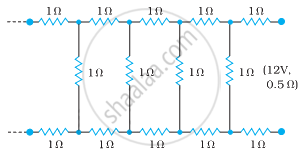
Determine the current drawn from a 12 V supply with internal resistance 0.5 Ω by the infinite network shown in the figure. Each resistor has 1 Ω resistance.
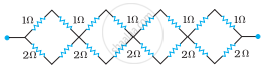
Determine the equivalent resistance of networks shown in Fig.
State Kirchhoff's rules for an electric network. Using Kirchhoff's rules, obtain the balance condition in terms of the resistances of four arms of Wheatstone bridge.
Consider the following two statements:-
(A) Kirchhoff's junction law follows from conservation of charge.
(B) Kirchhoff's loop law follows from conservative nature of electric field.
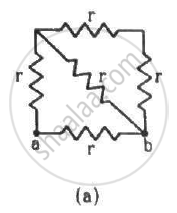
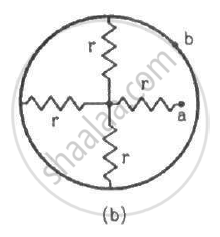
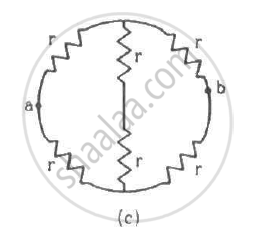
Find the equivalent resistances of the networks shown in the figure between the points a and b.
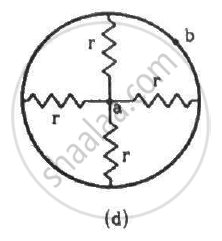
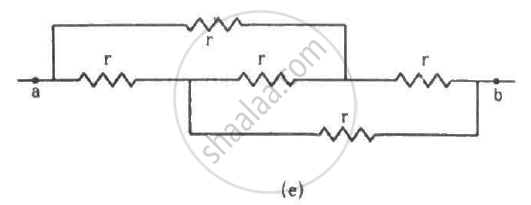
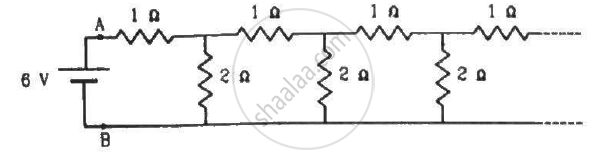
An infinite ladder is constructed with 1 Ω and 2 Ω resistors, as shown in the figure. (a) Find the effective resistance between the points A and B. (b) Find the current that passes through the 2 Ω resistor nearest to the battery.
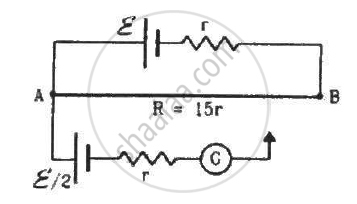
Consider the potentiometer circuit as arranged in the figure. The potentiometer wire is 600 cm long. (a) At what distance from the point A should the jockey touch the wire to get zero deflection in the galvanometer? (b) If the jockey touches the wire at a distance of 560 cm from A, what will be the current in the galvanometer?
A capacitor of capacitance 8.0 μF is connected to a battery of emf 6.0 V through a resistance of 24 Ω. Find the current in the circuit (a) just after the connections are made and (b) one time constant after the connections are made.
On which conservation principle is Kirchoff's Second Law of electrical networks based?
In the circuit shown in the figure below, E1 and E2 are two cells having emfs 2 V and 3 V respectively, and negligible internal resistance. Applying Kirchhoff’s laws of electrical networks, find the values of currents l1 and I2.

State Kirchhoff’s current rule.
State Kirchhoff ’s voltage rule.
State and explain Kirchhoff’s rules.
A copper wire of 10-6 m2 area of cross-section, carries a current of 2 A. If the number of electrons per cubic meter is 8 × 1028, calculate the current density and average drift velocity.
A potentiometer wire has a length of 4 m and resistance of 20 Ω. It is connected in series with resistance of 2980 Ω and a cell of emf 4 V. Calculate the potential along the wire.
Kirchhoff’s second law is a consequence of law of conservation of ______.
Figure shows current in a part of an electrical circuit. Then current I is ______.

The Kirchhoff's second law (ΣiR = ΣE), where the symbols have their usual meanings, is based on ______.
Three resistors having resistances r1, r2 and r3 are connected as shown in the given circuit. The ratio `i_3/i_1` of currents in terms of resistances used in the circuit is:
What are the advantages of the null-point method in a Wheatstone bridge? What additional measurements would be required to calculate `R_(unknown)` by any other method?
Power P is to be delivered to a device via transmission cables having resistance RC. If V is the voltage across R and I the current through it, find the power wasted and how can it be reduced.
The circuit in figure shows two cells connected in opposition to each other. Cell E1 is of emf 6V and internal resistance 2Ω; the cell E2 is of emf 4V and internal resistance 8Ω. Find the potential difference between the points A and B.
Two cells of voltage 10V and 2V and internal resistances 10Ω and 5Ω respectively, are connected in parallel with the positive end of 10V battery connected to negative pole of 2V battery (Figure). Find the effective voltage and effective resistance of the combination.

A 6-volt battery is connected to the terminals of a three-metre-long wire of uniform thickness and resistance of 100 ohms. The difference of potential between two points on the wire separated by a distance of 50 cm will be ______.
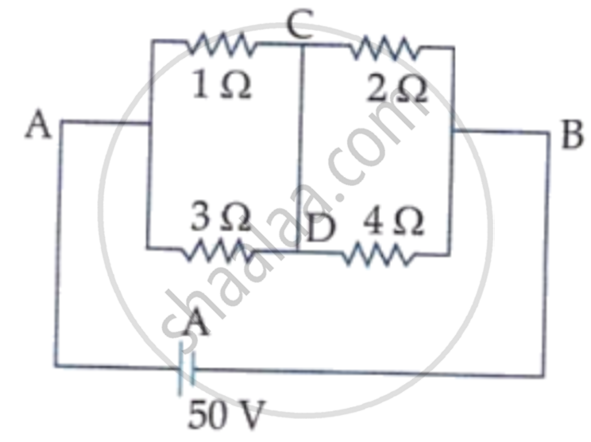
A constant voltage of 50 V is maintained between the points A and B of the circuit shown in the figure. The current through the branch CD of the circuit is:
Which two basic physical principles form the basis of Kirchhoff's laws?
Who gave Kirchhoff's laws?
At any junction, what does Kirchhoff's Current Law state?
What does Kirchhoff's Voltage Law state for a closed loop?
What is a loop?
After a charge completes one full loop and returns to its starting point, what is the net change in potential?
In a closed loop containing cells and resistors, what equals the total potential drop across the resistors?
