Advertisements
Advertisements
प्रश्न
A potentiometer wire has a length of 4 m and resistance of 20 Ω. It is connected in series with resistance of 2980 Ω and a cell of emf 4 V. Calculate the potential along the wire.
Advertisements
उत्तर
Given data:
l = 4m of R = 20Ω
In series with R’ = 2980Ω
E = 4 V
Since 20 is in series with 2980
Reff = 20 + 2980 = 3000
current I = `"V"/"R"_"eff" = 4/3000 = 1.3 xx 10^-3 "A"`
I = `1.3 xx 10^-3`A
Potential along the wire of 4 m length is,
`"V"/"l" - "IR"/"l" = (1.3 xx 10^-3 xx 20)/4`
`= (26 xx 10^-3)/4`
= 6.5 × 10⁻³ Vm-1
`"V"/"l" = 6.5 xx 10^-2 "Vm"^-1`
Potential = `0.65 xx 10^-2 "Vm"^-1`
APPEARS IN
संबंधित प्रश्न
Given n resistors each of resistance R, how will you combine them to get the (i) maximum (ii) minimum effective resistance? What is the ratio of the maximum to minimum resistance?
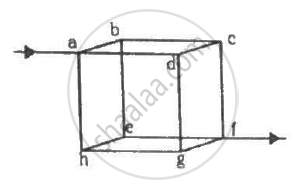
Twelve wires, each of equal resistance r, are joined to form a cube, as shown in the figure. Find the equivalent resistance between the diagonally-opposite points a and f.
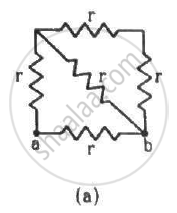
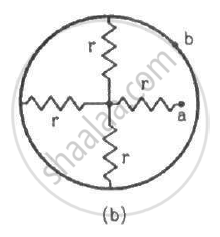
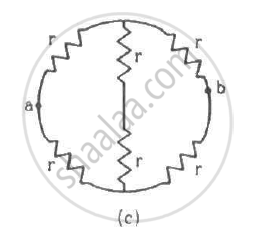
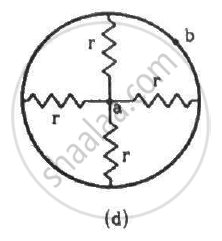
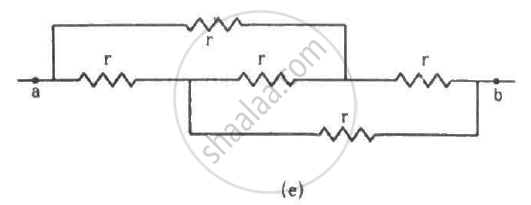
Find the equivalent resistances of the networks shown in the figure between the points a and b.
State Kirchhoff’s current rule.
Lightning is a very good example of a natural current. In typical lightning, there is 109 J energy transfer across the potential difference of 5 × 10⁷ V during a time interval of 0.2 s. Using this information, estimate the following quantities:
- the total amount of charge transferred between cloud and ground
- the current in the lightning bolt
- the power delivered in 0.2 s.

Kirchhoff’s junction rule is a reflection of ______.
- conservation of current density vector.
- conservation of charge.
- the fact that the momentum with which a charged particle approaches a junction is unchanged (as a vector) as the charged particle leaves the junction.
- the fact that there is no accumulation of charges at a junction.
What does Kirchhoff's Voltage Law state for a closed loop?
Why must the amount of charge entering a junction per second equal the amount leaving when current is steady?
Which sign convention is usually used for current entering a junction?
While moving opposite to the direction of current through a resistor, how is the potential change treated?
