Advertisements
Advertisements
प्रश्न
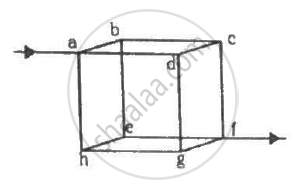
Twelve wires, each of equal resistance r, are joined to form a cube, as shown in the figure. Find the equivalent resistance between the diagonally-opposite points a and f.
Advertisements
उत्तर
Let V be the potential difference between the points a and f. Let current i enter a and leave from f. The distribution of current in various branches is shown in figure.
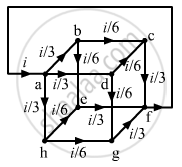
To calculate the potential difference between a and f, consider the path abcf and apply Kirchofff's Law:-
\[\frac{i}{3}r + \frac{i}{6}r + \frac{i}{3}r = V\]
\[\Rightarrow \left( \frac{2ir}{3} + \frac{ir}{6} \right) = V\]
\[ \Rightarrow \left( \frac{5ir}{6} \right) = V\]
The effective resistance between a and f,
\[R_{eff} = \frac{V}{i} = \frac{5}{6}r\]
APPEARS IN
संबंधित प्रश्न
State the two Kirchhoff’s rules used in electric networks. How are there rules justified?
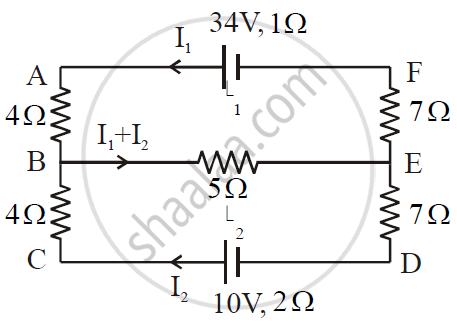
ε1 and ε2 are two batteries having emf of 34V and 10V respectively and internal resistance of 1Ω and 2Ω respectively. They are connected as shown in the figure below. Using Kirchhoff’s Laws of electrical networks, calculate the currents I1 and I2.
Given the resistances of 1 Ω, 2 Ω, 3 Ω, how will be combine them to get an equivalent resistance of 6 Ω?
Determine the equivalent resistance of networks shown in Fig.
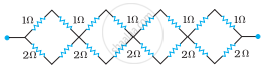
Determine the equivalent resistance of networks shown in Fig.
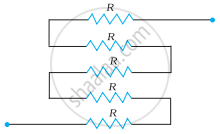
Calculate the value of the resistance R in the circuit shown in the figure so that the current in the circuit is 0.2 A. What would b the potential difference between points A and B?

In the given circuit, assuming point A to be at zero potential, use Kirchhoff’s rules to determine the potential at point B.

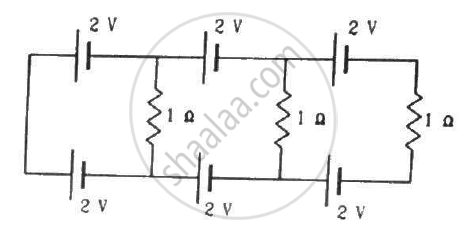
Find the circuit in the three resistors shown in the figure.
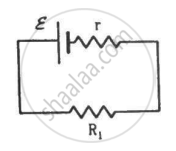
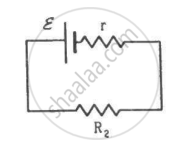
Two unequal resistances, R1 and R2, are connected across two identical batteries of emf ε and internal resistance r (see the figure). Can the thermal energies developed in R1 and R2 be equal in a given time? If yes, what will be the condition?
On which conservation principle is Kirchoff's Second Law of electrical networks based?
In the circuit shown in the figure below, E1 and E2 are two cells having emfs 2 V and 3 V respectively, and negligible internal resistance. Applying Kirchhoff’s laws of electrical networks, find the values of currents l1 and I2.

State the principle of potentiometer.
A copper wire of 10-6 m2 area of cross-section, carries a current of 2 A. If the number of electrons per cubic meter is 8 × 1028, calculate the current density and average drift velocity.
Figure shows current in a part of an electrical circuit. Then current I is ______.

Assertion: Kirchhoff’s junction rule follows from conservation of charge.
Reason: Kirchhoff’s loop rule follows from conservation of momentum.
Two cell of 1.25 V and 0.75 V are connected parallel. The effective voltage will be:-
Kirchhoff s second law is based on the law of conservation of ______
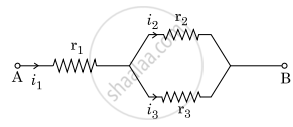
Three resistors having resistances r1, r2 and r3 are connected as shown in the given circuit. The ratio `"i"_3/"i"_1` of currents in terms of resistances used in the circuit is :
In a meter bridge the point D is a neutral point (Figure).
- The meter bridge can have no other neutral point for this set of resistances.
- When the jockey contacts a point on meter wire left of D, current flows to B from the wire.
- When the jockey contacts a point on the meter wire to the right of D, current flows from B to the wire through galvanometer.
- When R is increased, the neutral point shifts to left.
Why are alloys used for making standard resistance coils?
Two cells of voltage 10V and 2V and internal resistances 10Ω and 5Ω respectively, are connected in parallel with the positive end of 10V battery connected to negative pole of 2V battery (Figure). Find the effective voltage and effective resistance of the combination.

In the circuit shown in Figure below, E1 and E2 are batteries having emfs of 25V and 26V. They have an internal resistance of 1 Ω and 5 Ω respectively. Applying Kirchhoff’s laws of electrical networks, calculate the currents I1 and I2.

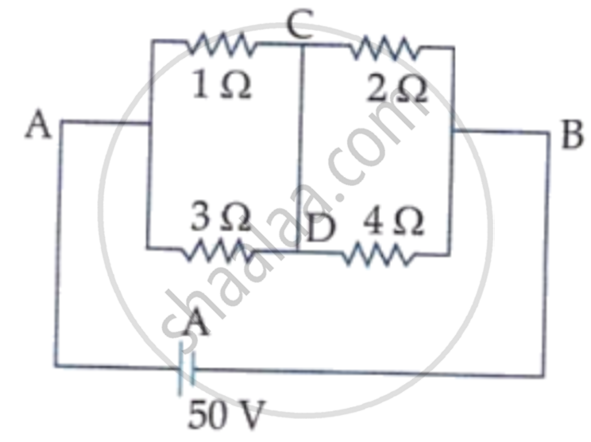
A constant voltage of 50 V is maintained between the points A and B of the circuit shown in the figure. The current through the branch CD of the circuit is:
Who gave Kirchhoff's laws?
What is Kirchhoff's Voltage Law also called?
What does Kirchhoff's Voltage Law state for a closed loop?
What is a branch?
What is a loop?
What is potential difference?
Why must the amount of charge entering a junction per second equal the amount leaving when current is steady?
If currents \[I_1\] and \[I_2\] enter a junction and currents \[I_3\] and \[I_4\] leave it, which equation follows from Kirchhoff's First Law?
After a charge completes one full loop and returns to its starting point, what is the net change in potential?
At junction P, currents \[0.2\,\mathrm{A}\], \[0.6\,\mathrm{A}\], and \[0.7\,\mathrm{A}\] point towards P, while \[0.4\,\mathrm{A}\], \[0.5\,\mathrm{A}\], and \[I\] point away. What is the unknown current?
