Advertisements
Advertisements
प्रश्न
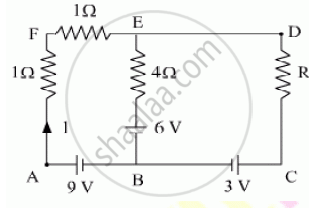
Using Kirchhoff’s rules determine the value of unknown resistance R in the circuit so that no current flows through 4 Ω resistance. Also find the potential difference between A and D.
Advertisements
उत्तर

Apply Kirchhoff’s In loop ABCFA:-
I + I + 4I1 = 9 − 6
2I + 4I1 = 3 … (1)
As there is no current flowing through the 4Ω resistance,
I1 = 0
Or, 2I = 3
Or, I = 1.5A
Thus the current through resistances R is 1.5A.
As there is no current through branch CF, thus equivalent circuit will be,
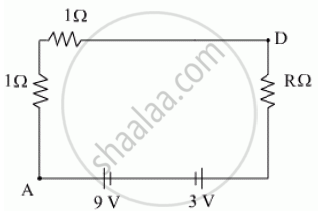
By applying Kirchhoff’s loop law we get,
1.5 + 1.5 + R (1.5) = 9 − 3
R = 2Ω
Potential difference between A and D = (9 − 3) = 6V
APPEARS IN
संबंधित प्रश्न
Kirchhoff's voltage law and current law are respectively in accordance with the conservation of .................................. .
- charge and momentum
- charge and energy
- energy and charge
- energy and momentum
Calculate the value of the resistance R in the circuit shown in the figure so that the current in the circuit is 0.2 A. What would b the potential difference between points B and E?

Calculate the value of the resistance R in the circuit shown in the figure so that the current in the circuit is 0.2 A. What would b the potential difference between points A and B?

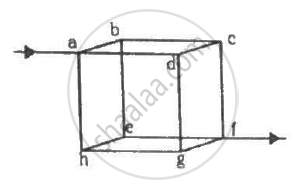
Twelve wires, each of equal resistance r, are joined to form a cube, as shown in the figure. Find the equivalent resistance between the diagonally-opposite points a and f.
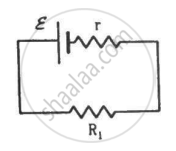
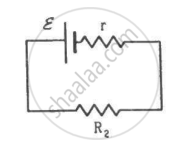
Two unequal resistances, R1 and R2, are connected across two identical batteries of emf ε and internal resistance r (see the figure). Can the thermal energies developed in R1 and R2 be equal in a given time? If yes, what will be the condition?
Solve the following question.
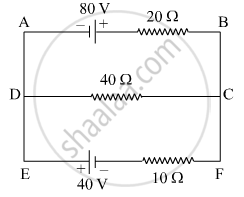
Using Kirchhoff’s rules, calculate the current through the 40 Ω and 20 Ω resistors in the following circuit.
State Kirchhoff’s current rule.
Obtain the condition for bridge balance in Wheatstone’s bridge.
Explain the determination of unknown resistance using meter bridge.
A potentiometer wire has a length of 4 m and resistance of 20 Ω. It is connected in series with resistance of 2980 Ω and a cell of emf 4 V. Calculate the potential along the wire.
Assertion: Kirchhoff’s junction rule follows from conservation of charge.
Reason: Kirchhoff’s loop rule follows from conservation of momentum.
The e.m.f of The battery in a thermocouple is doubled. The rate of heat generated at one of the junction will.
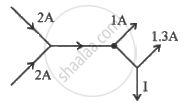
The figure below shows current in a part of electric circuit. The current I is ______.
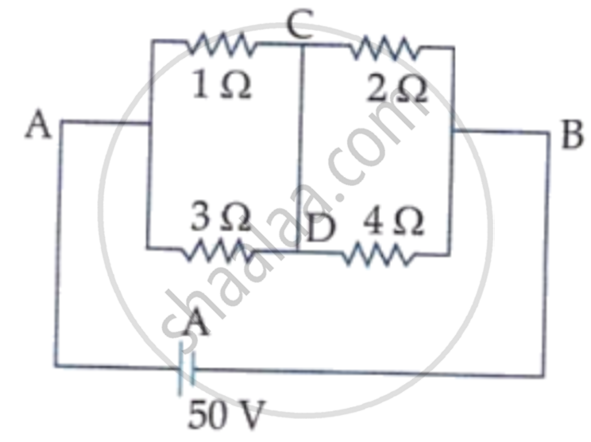
A constant voltage of 50 V is maintained between the points A and B of the circuit shown in the figure. The current through the branch CD of the circuit is:
Who gave Kirchhoff's laws?
What is Kirchhoff's Voltage Law also called?
What does Kirchhoff's Voltage Law state for a closed loop?
What is potential difference?
Which algebraic form is equivalent to \[I_1+I_2=I_3+I_4\]?
While moving opposite to the direction of current through a resistor, how is the potential change treated?
