Advertisements
Advertisements
प्रश्न
Lightning is a very good example of a natural current. In typical lightning, there is 109 J energy transfer across the potential difference of 5 × 10⁷ V during a time interval of 0.2 s. Using this information, estimate the following quantities:
- the total amount of charge transferred between cloud and ground
- the current in the lightning bolt
- the power delivered in 0.2 s.

Advertisements
उत्तर
Given data: E = 109J, V = 5 × 10⁷ V, t = 0.2s
(a) Total amount of charge-
W = qv `=> "q" = "W"/"V" = "E"/"V" = 10^9/(5 xx 10^7) = 0.2 xx 10^2`
q = 20 C
(b) current, I = `"q"/"t" = 20/0.2 = 200/2 = 100`
I = 100 A
(c) Power, P = VI = `5 xx 10^7 xx 100 = 5 xx 10^9`
APPEARS IN
संबंधित प्रश्न
Given the resistances of 1 Ω, 2 Ω, 3 Ω, how will be combine them to get an equivalent resistance of (11/5) Ω?
Calculate the value of the resistance R in the circuit shown in the figure so that the current in the circuit is 0.2 A. What would b the potential difference between points B and E?

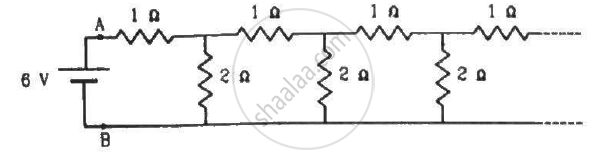
An infinite ladder is constructed with 1 Ω and 2 Ω resistors, as shown in the figure. (a) Find the effective resistance between the points A and B. (b) Find the current that passes through the 2 Ω resistor nearest to the battery.
On which conservation principle is Kirchoff's Second Law of electrical networks based?
A copper wire of 10-6 m2 area of cross-section, carries a current of 2 A. If the number of electrons per cubic meter is 8 × 1028, calculate the current density and average drift velocity.
Kirchhoff’s junction rule is a reflection of ______.
- conservation of current density vector.
- conservation of charge.
- the fact that the momentum with which a charged particle approaches a junction is unchanged (as a vector) as the charged particle leaves the junction.
- the fact that there is no accumulation of charges at a junction.
What are the advantages of the null-point method in a Wheatstone bridge? What additional measurements would be required to calculate `R_(unknown)` by any other method?
The value of current in the 6Ω resistance is ______.

A 6-volt battery is connected to the terminals of a three-metre-long wire of uniform thickness and resistance of 100 ohms. The difference of potential between two points on the wire separated by a distance of 50 cm will be ______.
What is the sign of the emf when moving from the negative terminal to the positive terminal of a cell?
