Advertisements
Advertisements
प्रश्न
A copper wire of 10-6 m2 area of cross-section, carries a current of 2 A. If the number of electrons per cubic meter is 8 × 1028, calculate the current density and average drift velocity.
Advertisements
उत्तर
A = 10-6 m2, I = 2A, n = 8 × 1028
Formula:
Current density, J = J = `"I"/"A"`
Drift velocity, `"V"_"d" = "J"/"ne"`
J = `"I"/"A" = 2/10^-6 = 2 xx 10^6`
J = `2xx10^6 "Am"^-2`
`"V"_"d" = "J"/"ne" = (2 xx 10^6)/(8 xx 10^28 xx 1.6 xx 10^-6)`
`"V"_"d" = = 0.1562 xx 10^-3`
`"V"_"d" = 15.6 xx 10^-5 "ms"^-1`
APPEARS IN
संबंधित प्रश्न
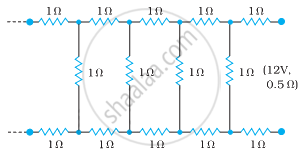
Determine the current drawn from a 12 V supply with internal resistance 0.5 Ω by the infinite network shown in the figure. Each resistor has 1 Ω resistance.
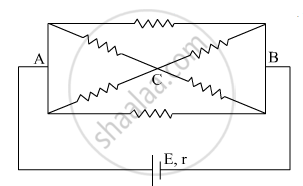
The current is drawn from a cell of emf E and internal resistance r connected to the network of resistors each of resistance r as shown in the figure. Obtain the expression for
- the current draw from the cell and
- the power consumed in the network.
In the given circuit, assuming point A to be at zero potential, use Kirchhoff’s rules to determine the potential at point B.

Twelve wires each having a resistance of 3 Ω are connected to form a cubical network. A battery of 10 V and negligible internal resistance is connected across the diagonally opposite corners of this network. Determine its equivalent resistance and the current along each edge of the cube.
State Kirchhoff’s current rule.
While measuring the length of the rod by vernier callipers, the reading on the main scale is 6.4 cm and the eight divisions on vernier is in line with marking on the main scale division. If the least count of callipers is 0.01 and zero error - 0.04 cm, the length of the rod is ______.
Two cell of 1.25 V and 0.75 V are connected parallel. The effective voltage will be:-
Why are alloys used for making standard resistance coils?
What is Kirchhoff's Current Law also called?
Which sign convention is usually used for current entering a junction?
