Advertisements
Advertisements
प्रश्न
State the two Kirchhoff’s rules used in the analysis of electric circuits and explain them.
Advertisements
उत्तर
- Junction rule: At any junction, the sum of the currents entering the junction is equal to the sum of currents leaving the junction.
- Loop rule: The algebraic sum of changes in potential around any closed loop involving resistors and cells in the loop is zero.
APPEARS IN
संबंधित प्रश्न
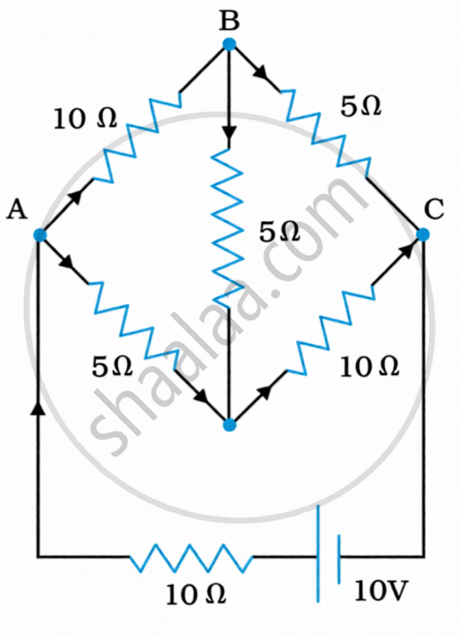
Determine the current in each branch of the network shown in figure.
State Kirchhoff's rules and explain on what basis they are justified.
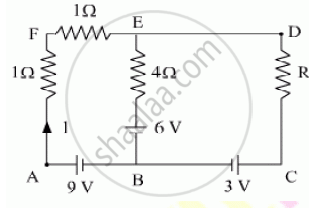
Using Kirchhoff’s rules determine the value of unknown resistance R in the circuit so that no current flows through 4 Ω resistance. Also find the potential difference between A and D.
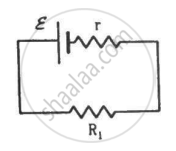
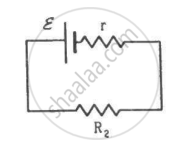
Two unequal resistances, R1 and R2, are connected across two identical batteries of emf ε and internal resistance r (see the figure). Can the thermal energies developed in R1 and R2 be equal in a given time? If yes, what will be the condition?
Solve the following question.
Using Kirchhoff’s rules, calculate the current through the 40 Ω and 20 Ω resistors in the following circuit.
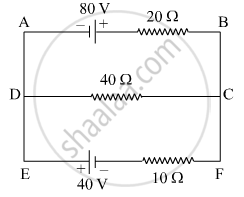
State Kirchhoff ’s voltage rule.
State the principle of potentiometer.
State and explain Kirchhoff’s rules.
Assertion: Kirchhoff’s junction rule follows from conservation of charge.
Reason: Kirchhoff’s loop rule follows from conservation of momentum.
While measuring the length of the rod by vernier callipers, the reading on the main scale is 6.4 cm and the eight divisions on vernier is in line with marking on the main scale division. If the least count of callipers is 0.01 and zero error - 0.04 cm, the length of the rod is ______.
Kirchhoff’s junction rule is a reflection of ______.
- conservation of current density vector.
- conservation of charge.
- the fact that the momentum with which a charged particle approaches a junction is unchanged (as a vector) as the charged particle leaves the junction.
- the fact that there is no accumulation of charges at a junction.
The circuit in figure shows two cells connected in opposition to each other. Cell E1 is of emf 6V and internal resistance 2Ω; the cell E2 is of emf 4V and internal resistance 8Ω. Find the potential difference between the points A and B.
Which two basic physical principles form the basis of Kirchhoff's laws?
What is Kirchhoff's Voltage Law also called?
What does Kirchhoff's Voltage Law state for a closed loop?
In a closed loop containing cells and resistors, what equals the total potential drop across the resistors?
What is the sign of the emf when moving from the negative terminal to the positive terminal of a cell?
How are Kirchhoff's laws used in analysing a general network with several unknown branch currents?
