Advertisements
Advertisements
Question
State the two Kirchhoff’s rules used in the analysis of electric circuits and explain them.
Advertisements
Solution
- Junction rule: At any junction, the sum of the currents entering the junction is equal to the sum of currents leaving the junction.
- Loop rule: The algebraic sum of changes in potential around any closed loop involving resistors and cells in the loop is zero.
APPEARS IN
RELATED QUESTIONS
Given the resistances of 1 Ω, 2 Ω, 3 Ω, how will be combine them to get an equivalent resistance of (11/5) Ω?
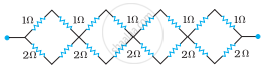
Determine the equivalent resistance of networks shown in Fig.
Calculate the value of the resistance R in the circuit shown in the figure so that the current in the circuit is 0.2 A. What would b the potential difference between points A and B?

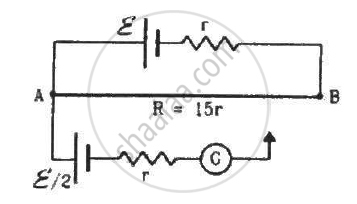
Consider the potentiometer circuit as arranged in the figure. The potentiometer wire is 600 cm long. (a) At what distance from the point A should the jockey touch the wire to get zero deflection in the galvanometer? (b) If the jockey touches the wire at a distance of 560 cm from A, what will be the current in the galvanometer?
On which conservation principle is Kirchoff's Second Law of electrical networks based?
Solve the following question.
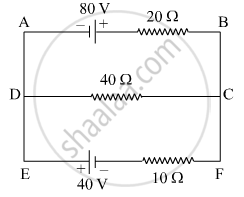
Using Kirchhoff’s rules, calculate the current through the 40 Ω and 20 Ω resistors in the following circuit.
A potentiometer wire has a length of 4 m and resistance of 20 Ω. It is connected in series with resistance of 2980 Ω and a cell of emf 4 V. Calculate the potential along the wire.
The Kirchhoff's second law (ΣiR = ΣE), where the symbols have their usual meanings, is based on ______.
What is the advantage of using thick metallic strips to join wires in a potentiometer?
Two cells of voltage 10V and 2V and internal resistances 10Ω and 5Ω respectively, are connected in parallel with the positive end of 10V battery connected to negative pole of 2V battery (Figure). Find the effective voltage and effective resistance of the combination.

The figure below shows two batteries, E1 and E2, having emfs of 18V and 10V and internal resistances of 1 Ω and 2 Ω, respectively. W1, W2 and W3 are uniform metallic wires AC, FD and BE having resistances of 8 Ω, 6 Ω and 10 Ω respectively. B and E are midpoints of the wires W1 and W2. Using Kirchhoff's laws of electrical circuits, calculate the current flowing in the wire W3:

At any junction, what does Kirchhoff's Current Law state?
What is Kirchhoff's Voltage Law also called?
Which term is defined as the rate of flow of charge through a conductor?
Which sign convention is usually used for current entering a junction?
Which sign convention is usually used for current leaving a junction?
While moving in the direction of current through a resistor, how is the potential change treated?
How are Kirchhoff's laws used in analysing a general network with several unknown branch currents?
