Advertisements
Advertisements
प्रश्न
Kirchhoff's junction law is equivalent to .............................
(a) conservation of energy.
(b) conservation of charge
(c) conservation of electric potential
(d) conservation of electric flux
Advertisements
उत्तर
(b) conservation of charge
APPEARS IN
संबंधित प्रश्न
Kirchhoff's voltage law and current law are respectively in accordance with the conservation of .................................. .
- charge and momentum
- charge and energy
- energy and charge
- energy and momentum
State the two Kirchhoff’s rules used in electric networks. How are there rules justified?
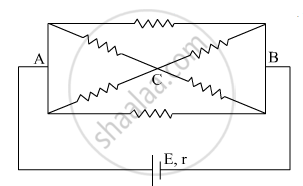
The current is drawn from a cell of emf E and internal resistance r connected to the network of resistors each of resistance r as shown in the figure. Obtain the expression for
- the current draw from the cell and
- the power consumed in the network.
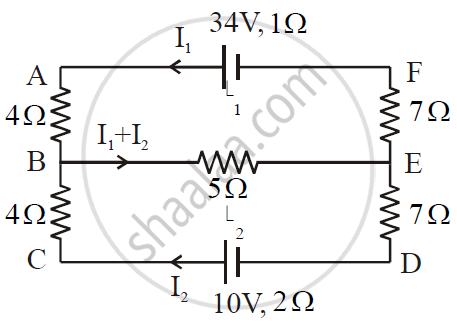
ε1 and ε2 are two batteries having emf of 34V and 10V respectively and internal resistance of 1Ω and 2Ω respectively. They are connected as shown in the figure below. Using Kirchhoff’s Laws of electrical networks, calculate the currents I1 and I2.
Given the resistances of 1 Ω, 2 Ω, 3 Ω, how will be combine them to get an equivalent resistance of (11/3) Ω?
Given the resistances of 1 Ω, 2 Ω, 3 Ω, how will be combine them to get an equivalent resistance of (6/11) Ω?
Using Kirchhoff’s rules determine the value of unknown resistance R in the circuit so that no current flows through 4 Ω resistance. Also find the potential difference between A and D.
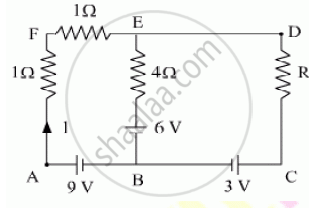
Calculate the value of the resistance R in the circuit shown in the figure so that the current in the circuit is 0.2 A. What would b the potential difference between points A and B?

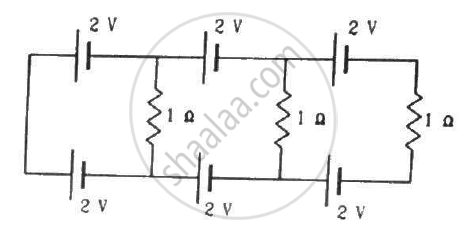
Find the circuit in the three resistors shown in the figure.
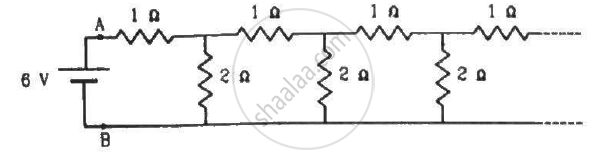
An infinite ladder is constructed with 1 Ω and 2 Ω resistors, as shown in the figure. (a) Find the effective resistance between the points A and B. (b) Find the current that passes through the 2 Ω resistor nearest to the battery.
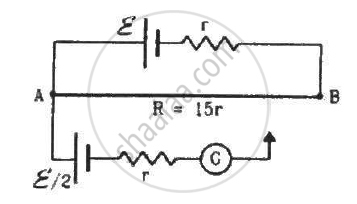
Consider the potentiometer circuit as arranged in the figure. The potentiometer wire is 600 cm long. (a) At what distance from the point A should the jockey touch the wire to get zero deflection in the galvanometer? (b) If the jockey touches the wire at a distance of 560 cm from A, what will be the current in the galvanometer?
State the principle of potentiometer.
State and explain Kirchhoff’s rules.
Obtain the condition for bridge balance in Wheatstone’s bridge.
Kirchhoff’s second law is a consequence of law of conservation of ______.
Two cell of 1.25 V and 0.75 V are connected parallel. The effective voltage will be:-
State the two Kirchhoff’s rules used in the analysis of electric circuits and explain them.
Which two basic physical principles form the basis of Kirchhoff's laws?
At any junction, what does Kirchhoff's Current Law state?
What is Kirchhoff's Voltage Law also called?
What does Kirchhoff's Voltage Law state for a closed loop?
Which pair of equations expresses the loop relationship for cells and resistors?
What is a branch?
Which term is defined as the rate of flow of charge through a conductor?
What is potential difference?
What is emf?
After a charge completes one full loop and returns to its starting point, what is the net change in potential?
