Advertisements
Advertisements
प्रश्न
Define the following:
One ohm
Advertisements
उत्तर
One ohm is the resistance of a component when the potential difference of one volt applied across the component drives a current of one ampere through it.
संबंधित प्रश्न
Will current flow more easily through a thick wire or a thin wire of the same material, when connected to the same source? Why?
Why are coils of electric toasters and electric irons made of an alloy rather than a pure metal?
A low voltage supply from which one needs high currents must have very low internal resistance. Why?
Name the unit of electrical resistance and give its symbol.
Keeping the p.d. constant, the resistance of a circuit is halved. The current will become:
(a) one-fourth
(b) four time
(c) half
(d) double
A resistance of 40 ohms and one of 60 ohms are arranged in series across 220 volt supply. Find the heat in joules produced by this combination of resistances in half a minute.
A car bulb connected to a 12 volt battery draws 2 A current when glowing. What is the resistance of the filament of the bulb? Will the resistance be more same or less when the bulb is not glowing?
A wire of resistance 9 ohm having length 30 cm is tripled on itself. What is its new resistance?
A wire has a length of 2.0 m and a resistance of 5.0 Ω. Find the electric field existing inside the wire if it carries a current of 10 A.
Calculate the effective resistance across AB?
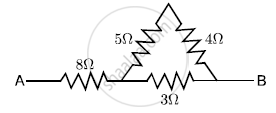
State the limitations of Ohm’s law.
What is non-ohmic resistor?
Draw a neat diagram for the verification of Ohm’s law by voltmeter-ammeter method. By another diagram show the relation between p.d. and current.
A wire connected to a power supply of 230 V has power dissipation P1. Suppose the wire is cut into two equal pieces and connected parallel to the same power supply. In this case, power dissipation is P2. The ratio of `"P"_2/"P"_1` is
Obtain the macroscopic form of Ohm’s law from its microscopic form and discuss its limitation.
A student carries out an experiment and plots the V-I graph of three samples of nichrome wire with resistances R1, R2 and R3 respectively. Which of the following is hue?

Assertion: The statement of Ohm’s law is K = IR.
Reason: V = IR is the equation which defines resistance.
In the context of Ohm's Law, Current (I) is defined as:
If the voltage across a conductor is increased while its temperature remains unchanged, what happens to the current flowing through it?
