Advertisements
Advertisements
प्रश्न
Define the following:
One ohm
Advertisements
उत्तर
One ohm is the resistance of a component when the potential difference of one volt applied across the component drives a current of one ampere through it.
संबंधित प्रश्न
Is Ohm’s law universally applicable for all conducting elements? If not, give examples of elements which do not obey Ohm’s law.
Calculate the electric field in a copper wire of cross-sectional area 2.0 mm2 carrying a current of 1 A.
The resistivity of copper = 1.7 × 10⁻⁸ Ω m
Calculate the effective resistance across AB?
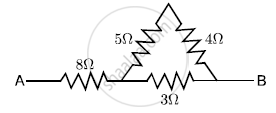
State the limitations of Ohm’s law.
SI unit of resistance is:
Define Current density.
Write a short note on superconductors?
An electronics hobbyist is building a radio which requires 150 Ω in her circuit, but she has only 220 Ω, 79 Ω, and 92 Ω resistors available. How can she connect the available resistors to get the desired value of resistance?
The temperature of a conductor is increased. The graph best showing the variation of its resistance is:
A heater of 220 V heats a volume of water m 5 mint time. A heater of 110 V heat in ten second. The resistance of the conductor is
What is the resistance of a conductor through which a current of 0.5 A flows when a potential difference of 2V is applied across its ends?
Let the resistance of an electrical device remain constant, while the potential difference across its two ends decreases to one fourth of its initial value. What change will occur in the current through it? State the law which helps us in solving the above stated question.
How is electric current related to the potential difference across the terminals of a conductor?
Draw a labelled circuit diagram to verify this relationship.
In the context of Ohm's Law, Current (I) is defined as:
The electric current between two joined conductors at different potentials continues to flow until:
From Ohm's Law, since \[I \propto V\], the constant ratio \[\frac{V}{I}\] is defined as:
Which of the following is an example of a Non-Ohmic material?
Which formula is used with Ohm's Law to help determine power consumption in an electrical circuit?
