Advertisements
Advertisements
Questions
Define the following:
One ohm
Advertisements
Solution
One ohm is the resistance of a component when the potential difference of one volt applied across the component drives a current of one ampere through it.
RELATED QUESTIONS
If the potential difference across the ends of a conductor is 220 V and the resistance of the conductor is 44 Ω (ohm), then the current flowing through is _________.
- 0.2 A
- 0.5 A
- 2 A
- 5 A
Is Ohm’s law universally applicable for all conducting elements? If not, give examples of elements which do not obey Ohm’s law.
What is an Ohmic resistor?
When a 12 V battery is connected across an unknown resistor, there is a current of 2.5 mA in the circuit. Calculate the value of the resistance of the resistor.
Name the law which is illustrated by the above V−I graph.
The resistors R1, R2, R3 and R4 in the figure given below are all equal in value.
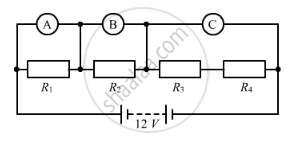
What would you expect the voltmeter A, B and C to read assuming that the connecting wires in the circuit have negligible resistance?
What is the necessary condition for a conductor to obey Ohm’s law?
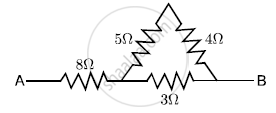
Calculate the effective resistance across AB?
The filament of a bulb takes a current 100 mA when potential difference across it is 0.2 V. When the potential difference across it becomes 1.0 V, the current becomes 400 mA. Calculate the resistance of filament in each case and account for the difference.
What are non-ohmic conductors? Give one exmaple. Draw a current-voltage graph for a non-ohmic conductor.
SI unit of resistance is:
What is non ohmic device?
Two cells each of 5V are connected in series across an 8Ω resistor and three parallel resistors of 4Ω, 6Ω, and 12Ω. Draw a circuit diagram for the above arrangement. Calculate
- the current drawn from the cell
- current through each resistor
The variable resistance is called ____________.
Assertion: The statement of Ohm’s law is K = IR.
Reason: V = IR is the equation which defines resistance.
The voltage - current readings of a certain material are shown in the table given below:
| Voltage (V) | 10 V | 20 V | 30 V |
| Current (I) | 2 A | 3 A | 4 A |
Study the table.
- State whether the conductor used is ohmic or non-ohmic.
- Justify your answer.
- State Ohm's law.
In which unit is the resistance of a conductor measured?
Which of the following is an example of a Non-Ohmic material?
