Advertisements
Advertisements
Question
How is electric current related to the potential difference across the terminals of a conductor?
Draw a labelled circuit diagram to verify this relationship.
Advertisements
Solution
V = IR, where V is potential difference, I is current and R is constant for a given resistor as its resistance. Hence, current I is directly proportional to V.

APPEARS IN
RELATED QUESTIONS
What will be the change in the current if the potential difference is kept constant and the resistance of the circuit is made four times?
- It will remain unchanged.
- It will become four times.
- It will become one-fourth.
- It will become half.
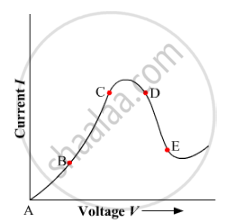
Graph showing the variation of current versus voltage for a material Ga As is shown in the figure. Identify the region of
(i) negative resistance
(ii) where Ohm's law is obeyed.
Write the formula of resistivity
Four resistances of 16 ohms each are connected in parallel. Four such combinations are connected in series. What is the total resistance?
Define ampere and volt with respect to Ohm’s law.
State Ohm’s law.
Define Current density.
Two cells of same emf E but internal resistance r1 and r2 are connected in series to an external resistor R (Figure). What should be the value of R so that the potential difference across the terminals of the first cell becomes zero.
A current of 3.2 mA flows through a conductor. If charge on an electron is −1.6 × 10⁻¹⁹ coulomb, find the number of electrons that will pass each second through the cross section of that conductor.
The mathematical form of Ohm's Law is:
