Advertisements
Advertisements
Question
A resistance of 40 ohms and one of 60 ohms are arranged in series across 220 volt supply. Find the heat in joules produced by this combination of resistances in half a minute.
Advertisements
Solution
The net resistance of the circuit, R = 40 + 60 = 100
Time for which current is passed = `1/2 minute =30s` minute = 30 s
Current in the circuit = `V/R=220/100 =2.2 A`
Heat produced = I2Rt = (2.2)2 (100) (30) = 4.84 x 100 x 30 = 14520 J
APPEARS IN
RELATED QUESTIONS
Find the resistance of a conductor if 0.24 A current is passing through it and a potential difference of 24 V is applied across it.
Let the resistance of an electrical component remains constant while the potential difference across the two ends of the component decreases to half of its former value. What change will occur in the current through it?
Write the SI unit of resistivity
Find the expression for the resistivity of a material and state the SI unit of resistivity.
The resistors R1, R2, R3 and R4 in the figure given below are all equal in value.
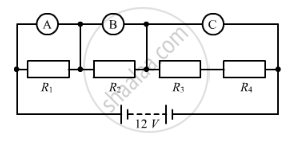
What would you expect the voltmeter A, B and C to read assuming that the connecting wires in the circuit have negligible resistance?
Calculate the current flowing through a wire of resistance 5 Ω connected to a battery of potential difference 3 V.
In the circuit shown below in Fig, calculate the value of x if the equivalent resistance between A and B is 4 Ω.

A metal sphere is kept on an insulting stands. A negatively charged rod is brought near it, then the sphere is earthed as shown. On removing the earthing, and taking the negatively charged rod away, what will be the nature of charge on the sphere? Give reason for your answer.

State the relation correlating the electric current flowing in a conductor and the voltage applied across it. Also, draw a graph to show this relationship.
What are non-ohmic conductors? Give one exmaple. Draw a current-voltage graph for a non-ohmic conductor.
State macroscopic form of Ohm’s law.
Write a short note on superconductors?
Which of the following is correct for V-I graph of a good conductor?

Calculate the total resistance of the circuit and find the total current in the circuit.
A metal rod of length 10 cm and a rectangular cross-section of 1 cm × `1/2` cm is connected to a battery across opposite faces. The resistance will be ______.
Suppose there is a circuit consisting of only resistances and batteries and we have to double (or increase it to n-times) all voltages and all resistances. Show that currents are unaltered. Do this for circuit of Example 3.7 in the NCERT Text Book for Class XII.
What is the resistance of a conductor through which a current of 0.5 A flows when a potential difference of 2V is applied across its ends?
How is electric current related to the potential difference across the terminals of a conductor?
Draw a labelled circuit diagram to verify this relationship.
If the voltage across a conductor is increased while its temperature remains unchanged, what happens to the current flowing through it?
