Advertisements
Advertisements
Question
State Ohm's Law. Represent it mathematically.
Advertisements
Solution
According to Ohm's law, "Electric current through a metallic conductor is directly proportional to potential difference across the conductor of the circuit provided that temperature remains constant."
Mathematical expression for Ohm's Law: I ∝ V.
Or V = IR
Or I = `"V"/"R"`
Where, R = constant called resistance of a given metal.
APPEARS IN
RELATED QUESTIONS
What will be the change in the current if the potential difference is kept constant and the resistance of the circuit is made four times?
- It will remain unchanged.
- It will become four times.
- It will become one-fourth.
- It will become half.
Name the unit of electrical resistance and give its symbol.
Name the law which is illustrated by the above V−I graph.
How much energy is consumed when a current of 5 amperes flows through the filament (or element) of a heater having resistance of 100 ohms for two hours? Express it in joules.
A wire of resistance 3 ohm and length 10 cm is stretched to length 30 cm. Assuming that it has a uniform cross section, what will be its new resistance?
Calculate the electric field in a copper wire of cross-sectional area 2.0 mm2 carrying a current of 1 A.
The resistivity of copper = 1.7 × 10⁻⁸ Ω m
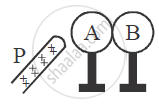
Two metallic spheres A and B kept on insulating stands are in contact with each other. A positively charged rod P is brought near the sphere A as shown in the figure. The two spheres are separated from each other, and the rod P is removed. What will be the nature of charges on spheres A and B?
Consider the sacle of voltmeter shown in the diagram and answer the following questions :

(a) What is the least count of the voltmeter?
(b) What is the reading shown by the voltmeter ?
(c) If the voltmeter is connected across a resistor of 20 `Omega` how much current is flowing through the resistor?
Write a short note on superconductors?
The variable resistance is called ____________.
