Advertisements
Advertisements
Question

Vinita and Ahmed demonstrated a circuit that operates the two headlights and the two sidelights of a car, in their school exhibition. Based on their demonstrated circuit, answer the following questions.
- State what happens when switch A is connected to:
a) Position 2
b) Position 3 - Find the potential difference across each lamp when lit.
- Calculate the current.
a) in each 12 Ω lamp when lit.
b) In each 4 Ω lamp when lit.
OR - Show, with calculations, which type of lamp, 4.0 Ω or 12 Ω, has the higher power.
Advertisements
Solution
- (a) 12 Ω lamps (only) on.
(b) 4 Ω lamps (only) on. - 12 V for both sets of lamps and all of them are in parallel.
- a) 12 Ω lamps are on when the wire is connected to position 2.
The voltage across both 12 Ω lamps = 12 V.
V = IR (Ohm’s law)
`"I" = "V"/"R" = 12/12 = 1 "A"`
b) 4 Ω lamps are on when the wire is connected to position 3.
The voltage across both 4 Ω lamps = 12 V.
V = IR (Ohm’s law)
`"I" = "V"/"R" = 12/4 = 3 "A"`
OR - `"P" = "V"^2/"R"`
All lamps are in parallel and hence the same V for all lamps.
For 4 Ω lamps → P = `(12 xx 12)/4` = 36 W
For 12 Ω lamps → P = `(12 xx 12)/12` = 12 W
Hence 4 Ω lamps will have higher power.
APPEARS IN
RELATED QUESTIONS
A low voltage supply from which one needs high currents must have very low internal resistance. Why?
The resistors R1, R2, R3 and R4 in the figure given below are all equal in value.
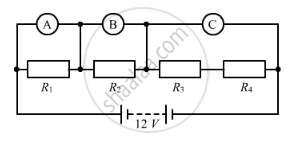
What would you expect the voltmeter A, B and C to read assuming that the connecting wires in the circuit have negligible resistance?
How does an increase in the temperature affect the specific resistance of a semiconductor?
State the limitations of Ohm’s law.
Answer the following question.
Distinguish between Ohmic and non-ohmic substances; explain with the help of example.
Write a short note on superconductors?
The slope of voltage (V) versus current (I) is called:

Assertion: The statement of Ohm’s law is K = IR.
Reason: V = IR is the equation which defines resistance.
A student carries out an experiment and plots the V-I graph of three samples of nichrome wire with resistances R1, R2 and R3 respectively. Which of the following is true?

A current of 3.2 mA flows through a conductor. If charge on an electron is −1.6 × 10⁻¹⁹ coulomb, find the number of electrons that will pass each second through the cross section of that conductor.
