Advertisements
Advertisements
प्रश्न

Vinita and Ahmed demonstrated a circuit that operates the two headlights and the two sidelights of a car, in their school exhibition. Based on their demonstrated circuit, answer the following questions.
- State what happens when switch A is connected to:
a) Position 2
b) Position 3 - Find the potential difference across each lamp when lit.
- Calculate the current.
a) in each 12 Ω lamp when lit.
b) In each 4 Ω lamp when lit.
OR - Show, with calculations, which type of lamp, 4.0 Ω or 12 Ω, has the higher power.
Advertisements
उत्तर
- (a) 12 Ω lamps (only) on.
(b) 4 Ω lamps (only) on. - 12 V for both sets of lamps and all of them are in parallel.
- a) 12 Ω lamps are on when the wire is connected to position 2.
The voltage across both 12 Ω lamps = 12 V.
V = IR (Ohm’s law)
`"I" = "V"/"R" = 12/12 = 1 "A"`
b) 4 Ω lamps are on when the wire is connected to position 3.
The voltage across both 4 Ω lamps = 12 V.
V = IR (Ohm’s law)
`"I" = "V"/"R" = 12/4 = 3 "A"`
OR - `"P" = "V"^2/"R"`
All lamps are in parallel and hence the same V for all lamps.
For 4 Ω lamps → P = `(12 xx 12)/4` = 36 W
For 12 Ω lamps → P = `(12 xx 12)/12` = 12 W
Hence 4 Ω lamps will have higher power.
APPEARS IN
संबंधित प्रश्न
Is Ohm’s law universally applicable for all conducting elements? If not, give examples of elements which do not obey Ohm’s law.
The graph between V and I for a conductor is a straight line passing through the origin.
- Which law is illustrated by such a graph?
- What should remain constant in a statement of this law?
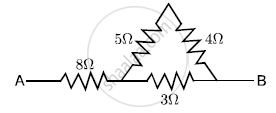
Calculate the effective resistance across AB?
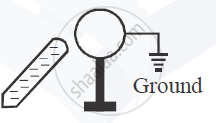
A metal sphere is kept on an insulting stands. A negatively charged rod is brought near it, then the sphere is earthed as shown. On removing the earthing, and taking the negatively charged rod away, what will be the nature of charge on the sphere? Give reason for your answer.
Tick(✓) the correct choice in the following:
Ohm's law is applicable to
- Name and state the law which relates the potential difference and current in a conductor.
- What is the necessary condition for a conductor to obey the law named above in part (a) ?
An electronics hobbyist is building a radio which requires 150 Ω in her circuit, but she has only 220 Ω, 79 Ω, and 92 Ω resistors available. How can she connect the available resistors to get the desired value of resistance?

Calculate the total resistance of the circuit and find the total current in the circuit.
In the context of Ohm's Law, Current (I) is defined as:
