Advertisements
Advertisements
Question
Two conductors are made of the same material and have the same length. Conductor A is a solid wire of diameter 1 mm. Conductor B is a hollow tube of outer diameter 2 mm and inner diameter 1 mm. Find the ratio of resistance RA to RB.
Advertisements
Solution
We know that the resistance of wire is `R = ρ l/A` where A is cross-sectional area of conductor and ρ is the specific resistance or resistivity and L is the length of conductor.
The resistance of first conductor
`R_A = (ρl)/(pi(10^-3 xx 0.5)^2`
The resistance of second conductor,
`R_B = (ρl)/(pi[(10^-3)^2 - (0.5 xx 10^-3)^2]`
Now, the ratio of two resistors is given by
`R_A/R_B = ((10^-3)^2 - (0.5 xx 10^-3)^2)/(0.5 xx 10^-3)^2` = 3:1
APPEARS IN
RELATED QUESTIONS
An electrical bulb is marked 200V, 100W. Calculate the electrical resistance of its filament. If five such
bulbs are connected in series to a 200V supply, how much current will flow through them?
Ohm's law gives a relationship between:
(a) current and resistance
(b) resistance and potential difference
(c) potential difference and electric charge
(d) current and potential difference
The graph between V and I for a conductor is a straight line passing through the origin.
- Which law is illustrated by such a graph?
- What should remain constant in a statement of this law?
How should the two resistances of 2 ohms each be connected so as to produce an equivalent resistance of 1 ohm?
The resistors R1, R2, R3 and R4 in the figure given below are all equal in value.
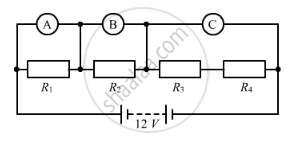
What would you expect the voltmeter A, B and C to read assuming that the connecting wires in the circuit have negligible resistance?
How much energy is consumed when a current of 5 amperes flows through the filament (or element) of a heater having resistance of 100 ohms for two hours? Express it in joules.
Draw a neat diagram for the verification of Ohm’s law by voltmeter-ammeter method. By another diagram show the relation between p.d. and current.
Define Current density.
State microscopic form of Ohm’s law.
State macroscopic form of Ohm’s law.
What is non ohmic device?
State Ohm’s law? How can it be verified experimentally? Does it hold good under all conditions? Comment.
Ohm's law deals with the relationship between ______
Two cells of same emf E but internal resistance r1 and r2 are connected in series to an external resistor R (Figure). What should be the value of R so that the potential difference across the terminals of the first cell becomes zero.
The resistance of a resistor is reduced to half of its initial value. If other parameters of the electrical circuit remain unaltered, the amount of heat produced in the resistor will become ______.
The circuit depicted in the figure is employed for studying Ohm’s Law. Instead of using a standard resistor, a student opts for a glass tube filled with mercury (tube 1), connected to the circuit through two electrodes, E1 and E2. He records the readings of the ammeter and voltmeter, thereby calculating the resistance. The student repeats the experiment by substituting tube 1 with tube 2, where the same amount of mercury fills tube 2.
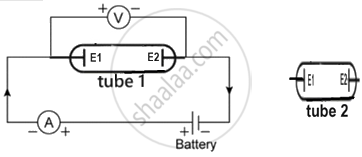
Neglecting internal resistance of the cell use (> or < or =) to compare:
- the resistance in both the cases.
- the voltmeter readings in both the cases.
- the specific resistance in both the cases.
Which of the following correctly defines Potential Difference (V) as one of the three core quantities of Ohm's Law?
A resistor is connected in a circuit with a voltage of 12 V and a resistance of 24 Ω. What is the current flowing through the resistor?
If the voltage across a conductor is increased while its temperature remains unchanged, what happens to the current flowing through it?
