Advertisements
Advertisements
Question
How does an increase in the temperature affect the specific resistance of a :
(i) Metal and
(ii) Semiconductor ?
Advertisements
Solution
(i) Metal : Specific resistance increases
(ii) Semiconductor : Specific resistance decreases
APPEARS IN
RELATED QUESTIONS
What is Resistivity?
Write the SI unit of resistivity
The resistors R1, R2, R3 and R4 in the figure given below are all equal in value.
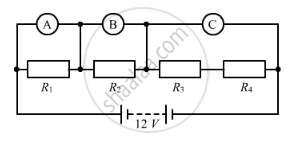
What would you expect the voltmeter A, B and C to read assuming that the connecting wires in the circuit have negligible resistance?
A wire of resistance 9 ohm having length 30 cm is tripled on itself. What is its new resistance?
Show by a diagram how two resistors R1 and R2 are joined in parallel. Obtain an expression for the total resistance of the combination.
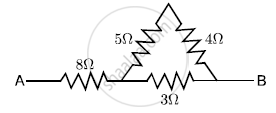
Calculate the effective resistance across AB?
A metal sphere is kept on an insulting stands. A negatively charged rod is brought near it, then the sphere is earthed as shown. On removing the earthing, and taking the negatively charged rod away, what will be the nature of charge on the sphere? Give reason for your answer.

Define the following:
Coulomb
The resistance of a nichrome wire at 0°C is 10Ω. If its temperature coefficient of resistivity of nichrome is 0.004/ °C, find its resistance of the wire at boiling point of water. Comment on the result.
The heat produced by a 100 w heater in 2 minute is equal to
