Advertisements
Advertisements
प्रश्न
How does an increase in the temperature affect the specific resistance of a :
(i) Metal and
(ii) Semiconductor ?
Advertisements
उत्तर
(i) Metal : Specific resistance increases
(ii) Semiconductor : Specific resistance decreases
APPEARS IN
संबंधित प्रश्न
An electric bulb draws 1.2 A current at 6.0 V. Find the resistance of filament of bulb while glowing.
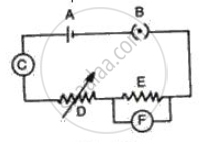
Fig. represents the circuit used for the verification of ohm's law. Label the different parts from A and F. State the function of each.
SI unit of resistance is:
Ohm’s law states the relationship between power and voltage.
Define temperature coefficient of resistance.
A student carries out an experiment and plots the V-I graph of three samples of nichrome wire with resistances R1, R2 and R3 respectively. Which of the following is hue?

A heater of 220 V heats a volume of water m 5 mint time. A heater of 110 V heat in ten second. The resistance of the conductor is
A metal rod of length 10 cm and a rectangular cross-section of 1 cm × `1/2` cm is connected to a battery across opposite faces. The resistance will be ______.
How is electric current related to the potential difference across the terminals of a conductor?
Draw a labelled circuit diagram to verify this relationship.
Why should an ammeter have low resistance?
