Advertisements
Advertisements
प्रश्न
SI unit of resistance is:
पर्याय
mho
joule
ohm
ohm meter
Advertisements
उत्तर
ohm
APPEARS IN
संबंधित प्रश्न
What will be the change in the current if the potential difference is kept constant and the resistance of the circuit is made four times?
- It will remain unchanged.
- It will become four times.
- It will become one-fourth.
- It will become half.
How would you connect two resistors in series? Draw a diagram. Calculate the total equivalent resistance.
In the circuit shown below in Fig, calculate the value of x if the equivalent resistance between A and B is 4 Ω.

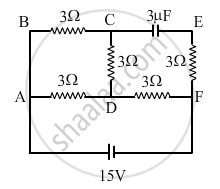
In the circuit shown in the figure, find the total resistance of the circuit and the current in the arm AD.
A wire has a length of 2.0 m and a resistance of 5.0 Ω. Find the electric field existing inside the wire if it carries a current of 10 A.
A metal sphere is kept on an insulting stands. A negatively charged rod is brought near it, then the sphere is earthed as shown. On removing the earthing, and taking the negatively charged rod away, what will be the nature of charge on the sphere? Give reason for your answer.

The filament of a bulb takes a current 100 mA when potential difference across it is 0.2 V. When the potential difference across it becomes 1.0 V, the current becomes 400 mA. Calculate the resistance of filament in each case and account for the difference.
Consider a current carrying wire (current I) in the shape of a circle. Note that as the current progresses along the wire, the direction of j (current density) changes in an exact manner, while the current I remain unaffected. The agent that is essentially responsible for is ______.
Ohm's Law states that for a metallic conductor, the current flowing through it is directly proportional to the potential difference across its ends, provided that:
