Advertisements
Advertisements
प्रश्न
A metal sphere is kept on an insulting stands. A negatively charged rod is brought near it, then the sphere is earthed as shown. On removing the earthing, and taking the negatively charged rod away, what will be the nature of charge on the sphere? Give reason for your answer.

Advertisements
उत्तर १
There will be positive charge on the sphere.
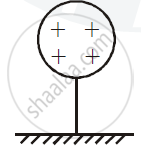
Reason :
Negatively charged rod will induce positive charge on the sphere and negative charge well move in ground from other end.
उत्तर २
When we bring a negatively charged rod near the metal sphere, the free electrons in the sphere move away due to repulsion force and start piling up at the other end. The rear end becomes positively charged due to the deficit of electrons. After connecting the sphere to the ground, the electrons flow to the ground while the positive charges at the rear end remain as it is due to the attractive force of the negative charges on the rod. When the sphere is disconnected from the ground and the charged rod is removed, the positive charge spreads uniformly over the sphere as shown in the Figure below:

संबंधित प्रश्न
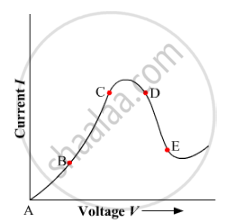
Graph showing the variation of current versus voltage for a material Ga As is shown in the figure. Identify the region of
(i) negative resistance
(ii) where Ohm's law is obeyed.
Will current flow more easily through a thick wire or a thin wire of the same material, when connected to the same source? Why?
How should the two resistances of 2 ohms each be connected so as to produce an equivalent resistance of 1 ohm?
What length of copper wire of resistivity 1.7 × 10⁻⁸ Ω m and radius 1 mm is required so that its resistance is 2Ω?
Define the following:
Coulomb
A heater of 220 V heats a volume of water m 5 mint time. A heater of 110 V heat in ten second. The resistance of the conductor is
You are provided with a resistor, a key, an ammeter, a voltmeter, four cells of 1.5 V each and few connecting wires. Using circuit components, draw a labelled circuit diagram to show the setup to study Ohm's law.
State the relationship between potential difference (V) across the resistor and the current (I) flowing through it. Also draw V-I graph, taking V on the X-axis.
How is electric current related to the potential difference across the terminals of a conductor?
Draw a labelled circuit diagram to verify this relationship.
What is the nature of the graph obtained when potential difference is plotted against current for an Ohmic conductor?
A resistor is connected in a circuit with a voltage of 12 V and a resistance of 24 Ω. What is the current flowing through the resistor?
