Advertisements
Advertisements
प्रश्न
Choose the correct alternative.
Which of the following is an ohmic conductor?
पर्याय
transistor
vacuum tube
electrolyte
nichrome wire
Advertisements
उत्तर
nichrome wire
APPEARS IN
संबंधित प्रश्न
Find the resistance of a conductor if 0.24 A current is passing through it and a potential difference of 24 V is applied across it.
An electrical bulb is marked 200V, 100W. Calculate the electrical resistance of its filament. If five such
bulbs are connected in series to a 200V supply, how much current will flow through them?
Ohm's law gives a relationship between:
(a) current and resistance
(b) resistance and potential difference
(c) potential difference and electric charge
(d) current and potential difference
Fill in the following blank with suitable words:
Resistance is measured in .............. The resistance of a wire increases as the length ..............; as the temperature ..............; and as the cross-sectional area .............. .
How much energy is consumed when a current of 5 amperes flows through the filament (or element) of a heater having resistance of 100 ohms for two hours? Express it in joules.
- Draw a V-I graph for a conductor obeying Ohm’s law.
- What does the slope of V–I graph for a conductor represent?
In an experiment of verification of Ohm’s law following observations are obtained.
|
Potential difference V (in volt) |
0.5 | 1.0 | 1.5 | 2.0 | 2.5 |
| current I (in ampere) | 0.2 | 0.4 | 0.6 | 0.8 | 1.0 |
Draw a V-I graph and use this graph to find:
- the potential difference V when the current I is 0.5 A,
- the current I when the potential difference V is 0.75 V,
- the resistance in a circuit.
A wire of resistance 9 ohm having length 30 cm is tripled on itself. What is its new resistance?
How would you connect two resistors in series? Draw a diagram. Calculate the total equivalent resistance.
In the circuit shown in the figure, find the total resistance of the circuit and the current in the arm AD.
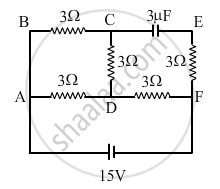
Define the following:
Coulomb
State Ohm’s law.
State microscopic form of Ohm’s law.
Obtain the macroscopic form of Ohm’s law from its microscopic form and discuss its limitation.
Which of the following I-V graph represents ohmic conductors?
The slope of voltage (V) versus current (I) is called:

A student carries out an experiment and plots the V-I graph of three samples of nichrome wire with resistances R1, R2 and R3 respectively. Which of the following is hue?

A current of 2amp flowing through a conductor produced 80 joule of heat in 10 sec. The resistance of the conductor is:-
The heat produced by a 100 w heater in 2 minute is equal to
Two conductors are made of the same material and have the same length. Conductor A is a solid wire of diameter 1 mm. Conductor B is a hollow tube of outer diameter 2 mm and inner diameter 1 mm. Find the ratio of resistance RA to RB.
Suppose there is a circuit consisting of only resistances and batteries and we have to double (or increase it to n-times) all voltages and all resistances. Show that currents are unaltered. Do this for circuit of Example 3.7 in the NCERT Text Book for Class XII.
The resistance of a resistor is reduced to half of its initial value. If other parameters of the electrical circuit remain unaltered, the amount of heat produced in the resistor will become ______.
Ohm's Law states that for a metallic conductor, the current flowing through it is directly proportional to the potential difference across its ends, provided that:
Which of the following correctly defines Potential Difference (V) as one of the three core quantities of Ohm's Law?
Resistance (R) in a conductor is best described as:
The mathematical form of Ohm's Law is:
In which unit is the resistance of a conductor measured?
From Ohm's Law, since \[I \propto V\], the constant ratio \[\frac{V}{I}\] is defined as:
Which of the following is an example of a Non-Ohmic material?
