Advertisements
Advertisements
प्रश्न
Choose the correct alternative.
Which of the following is an ohmic conductor?
विकल्प
transistor
vacuum tube
electrolyte
nichrome wire
Advertisements
उत्तर
nichrome wire
APPEARS IN
संबंधित प्रश्न
Will current flow more easily through a thick wire or a thin wire of the same material, when connected to the same source? Why?
Why are coils of electric toasters and electric irons made of an alloy rather than a pure metal?
Write the SI unit of resistivity
Four resistances of 16 ohms each are connected in parallel. Four such combinations are connected in series. What is the total resistance?
What is an ohmic resistor? Give one example of an ohmic resistor. Draw a graph to show its current voltage relationship. How is the resistance of the resistor determined from this graph?
A car bulb connected to a 12 volt battery draws 2 A current when glowing. What is the resistance of the filament of the bulb? Will the resistance be more same or less when the bulb is not glowing?
A wire of resistance 9 ohm having length 30 cm is tripled on itself. What is its new resistance?
How would you connect two resistors in series? Draw a diagram. Calculate the total equivalent resistance.
Calculate the electric field in a copper wire of cross-sectional area 2.0 mm2 carrying a current of 1 A.
The resistivity of copper = 1.7 × 10⁻⁸ Ω m
How does an increase in the temperature affect the specific resistance of a semiconductor?
Consider the sacle of voltmeter shown in the diagram and answer the following questions :

(a) What is the least count of the voltmeter?
(b) What is the reading shown by the voltmeter ?
(c) If the voltmeter is connected across a resistor of 20 `Omega` how much current is flowing through the resistor?
Fig. represents the circuit used for the verification of Ohm's law. Label the parts from A to F. state the function of each.
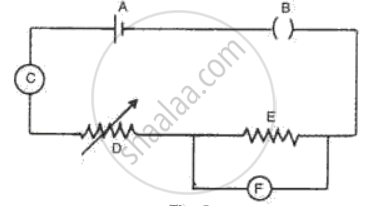
- Name and state the law which relates the potential difference and current in a conductor.
- What is the necessary condition for a conductor to obey the law named above in part (a) ?
Rewrite the following statement by selecting the correct option.
The S.I. unit of resistance is __________.
State and define Ohm’s law.
A wire connected to a power supply of 230 V has power dissipation P1. Suppose the wire is cut into two equal pieces and connected parallel to the same power supply. In this case, power dissipation is P2. The ratio of `"P"_2/"P"_1` is
Define Current density.
State microscopic form of Ohm’s law.
The unit of specific resistance is ____________.
Assertion: The statement of Ohm’s law is K = IR.
Reason: V = IR is the equation which defines resistance.
A metal rod of length 10 cm and a rectangular cross-section of 1 cm × `1/2` cm is connected to a battery across opposite faces. The resistance will be ______.
State Ohm's Law. Represent it mathematically.
The resistance of a resistor is reduced to half of its initial value. If other parameters of the electrical circuit remain unaltered, the amount of heat produced in the resistor will become ______.
Ohm's Law states that for a metallic conductor, the current flowing through it is directly proportional to the potential difference across its ends, provided that:
When two conductors at different electric potentials are joined by a metallic wire, in which direction do the electrons flow?
The electric current between two joined conductors at different potentials continues to flow until:
Which of the following describes the V-I relation for an Ohmic conductor?
A resistor is connected in a circuit with a voltage of 12 V and a resistance of 24 Ω. What is the current flowing through the resistor?
