Advertisements
Advertisements
प्रश्न
Suppose there is a circuit consisting of only resistances and batteries and we have to double (or increase it to n-times) all voltages and all resistances. Show that currents are unaltered. Do this for circuit of Example 3.7 in the NCERT Text Book for Class XII.
Advertisements
उत्तर
Let us first assume the equivalent internal resistance of the battery is Reff, the equivalent external resistance R and the equivalent voltage of the battery is Veff.
Now by applying Ohm's law,
Then current through R is given by `I = (V_"eff")/(R_"eff" + R)`
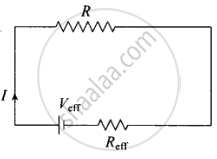
Now according to the question if all the resistances and the effective voltage are increased n-times, then we have
`V_("eff")^("new") = nV_("eff"), R_("eff")^("new") = nR_("eff")`
And Rnew = nR
Then, the new current is given by
`I^' = (nV_("eff"))/(nR_("eff") + nR) = (n(V_("eff")))/(n(R_("eff") + R)) = ((V_("eff")))/((R_("eff") + R)) = I`
The last result of two equations is same, so we can say that current remains the same.
APPEARS IN
संबंधित प्रश्न
If the potential difference across the ends of a conductor is 220 V and the resistance of the conductor is 44 Ω (ohm), then the current flowing through is _________.
- 0.2 A
- 0.5 A
- 2 A
- 5 A
A low voltage supply from which one needs high currents must have very low internal resistance. Why?
What is an Ohmic resistor?
Name the physical quantity whose unit is "ohm".
How much energy is consumed when a current of 5 amperes flows through the filament (or element) of a heater having resistance of 100 ohms for two hours? Express it in joules.
State Ohm’s law and draw a neat labelled circuit diagram containing a battery, a key, a voltmeter, an ammeter, a rheostat and an unknown resistance to verify it.
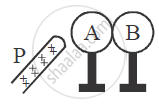
Two metallic spheres A and B kept on insulating stands are in contact with each other. A positively charged rod P is brought near the sphere A as shown in the figure. The two spheres are separated from each other, and the rod P is removed. What will be the nature of charges on spheres A and B?
A metal sphere is kept on an insulting stands. A negatively charged rod is brought near it, then the sphere is earthed as shown. On removing the earthing, and taking the negatively charged rod away, what will be the nature of charge on the sphere? Give reason for your answer.

Tick(✓) the correct choice in the following:
Ohm's law is applicable to
Define the following:
Coulomb
What are non-ohmic conductors? Give one exmaple. Draw a current-voltage graph for a non-ohmic conductor.
SI unit of resistance is:
What is non ohmic device?
A current of 2amp flowing through a conductor produced 80 joule of heat in 10 sec. The resistance of the conductor is:-
Consider a current carrying wire (current I) in the shape of a circle. Note that as the current progresses along the wire, the direction of j (current density) changes in an exact manner, while the current I remain unaffected. The agent that is essentially responsible for is ______.
Two cells of same emf E but internal resistance r1 and r2 are connected in series to an external resistor R (Figure). What should be the value of R so that the potential difference across the terminals of the first cell becomes zero.
What is meant by resistance of a conductor ? Define its SI unit.
A current of 3.2 mA flows through a conductor. If charge on an electron is −1.6 × 10⁻¹⁹ coulomb, find the number of electrons that will pass each second through the cross section of that conductor.
