Advertisements
Advertisements
प्रश्न
Two cells of voltage 10V and 2V and internal resistances 10Ω and 5Ω respectively, are connected in parallel with the positive end of 10V battery connected to negative pole of 2V battery (Figure). Find the effective voltage and effective resistance of the combination.

Advertisements
उत्तर
In this problem first, we are applying Kirchhoff's junction rule at c, I1 = I + I2
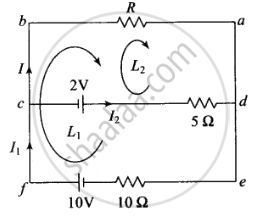
Applying Kirchhoff's voltage law in loop (e – f – b – a – e) loop L1 outer loop, then we get
10 – IR – 10l1 = 0
10 = IR + 10l1 ......(i)
Applying Kirchhoff's voltage law in loop (c – b – a – d – c) loop L2, we get
– 2 – IR + 5I2 = 0
2 = 5I2 – RI
As we know, I1 = I + I2 then
I2 = I1 – I
So the above equation can be written as
2 = 5(I1 – I) – RI
or 4 = 10I1 – 10I – 2RI ......(ii)
Subtracting equations (ii) from (i), we get
⇒ 6 = 3RI + 10I
2 = `I(R + 10/3)`
Also, the external resistance is R. The Ohm's law states that V = I(R + Reff)
On comparing, we have V = 2V and effective internal resistance `(R_("eff")) = (10/3)Ω`
Since, the equivalent internal resistance (Reff) of two cells is `(10/3)Ω`, being the parallel combination of 5Ω and 10Ω. The equivalent circuit is given below:

APPEARS IN
संबंधित प्रश्न
Kirchhoff's voltage law and current law are respectively in accordance with the conservation of .................................. .
- charge and momentum
- charge and energy
- energy and charge
- energy and momentum
Use Kirchhoff's rules to obtain conditions for the balance condition in a Wheatstone bridge.
Given the resistances of 1 Ω, 2 Ω, 3 Ω, how will be combine them to get an equivalent resistance of (11/3) Ω?
Given the resistances of 1 Ω, 2 Ω, 3 Ω, how will be combine them to get an equivalent resistance of (11/5) Ω?
Given the resistances of 1 Ω, 2 Ω, 3 Ω, how will be combine them to get an equivalent resistance of 6 Ω?
Given the resistances of 1 Ω, 2 Ω, 3 Ω, how will be combine them to get an equivalent resistance of (6/11) Ω?
State Kirchhoff's rules for an electric network. Using Kirchhoff's rules, obtain the balance condition in terms of the resistances of four arms of Wheatstone bridge.
Calculate the value of the resistance R in the circuit shown in the figure so that the current in the circuit is 0.2 A. What would b the potential difference between points B and E?

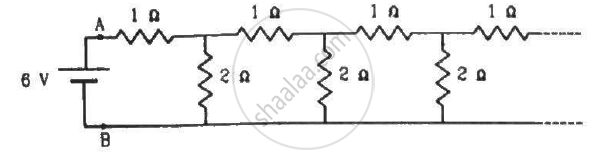
An infinite ladder is constructed with 1 Ω and 2 Ω resistors, as shown in the figure. (a) Find the effective resistance between the points A and B. (b) Find the current that passes through the 2 Ω resistor nearest to the battery.
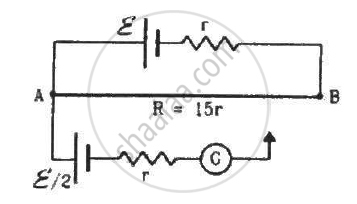
Consider the potentiometer circuit as arranged in the figure. The potentiometer wire is 600 cm long. (a) At what distance from the point A should the jockey touch the wire to get zero deflection in the galvanometer? (b) If the jockey touches the wire at a distance of 560 cm from A, what will be the current in the galvanometer?
On which conservation principle is Kirchoff's Second Law of electrical networks based?
State Kirchhoff’s current rule.
State Kirchhoff ’s voltage rule.
State and explain Kirchhoff’s rules.
A potentiometer wire has a length of 4 m and resistance of 20 Ω. It is connected in series with resistance of 2980 Ω and a cell of emf 4 V. Calculate the potential along the wire.
In a potentiometer arrangement, a cell of emf 1.25 V gives a balance point at 35 cm length of the wire. If the cell is replaced by another cell and the balance point shifts to 63 cm, what is the emf of the second cell?
The e.m.f of The battery in a thermocouple is doubled. The rate of heat generated at one of the junction will.
Kirchhoff s second law is based on the law of conservation of ______
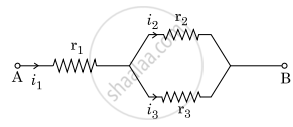
Three resistors having resistances r1, r2 and r3 are connected as shown in the given circuit. The ratio `"i"_3/"i"_1` of currents in terms of resistances used in the circuit is :
In a meter bridge the point D is a neutral point (Figure).
- The meter bridge can have no other neutral point for this set of resistances.
- When the jockey contacts a point on meter wire left of D, current flows to B from the wire.
- When the jockey contacts a point on the meter wire to the right of D, current flows from B to the wire through galvanometer.
- When R is increased, the neutral point shifts to left.
What are the advantages of the null-point method in a Wheatstone bridge? What additional measurements would be required to calculate `R_(unknown)` by any other method?
Power P is to be delivered to a device via transmission cables having resistance RC. If V is the voltage across R and I the current through it, find the power wasted and how can it be reduced.
State the two Kirchhoff’s rules used in the analysis of electric circuits and explain them.
In the circuit shown in Figure below, E1 and E2 are batteries having emfs of 25V and 26V. They have an internal resistance of 1 Ω and 5 Ω respectively. Applying Kirchhoff’s laws of electrical networks, calculate the currents I1 and I2.

The figure below shows two batteries, E1 and E2, having emfs of 18V and 10V and internal resistances of 1 Ω and 2 Ω, respectively. W1, W2 and W3 are uniform metallic wires AC, FD and BE having resistances of 8 Ω, 6 Ω and 10 Ω respectively. B and E are midpoints of the wires W1 and W2. Using Kirchhoff's laws of electrical circuits, calculate the current flowing in the wire W3:

Which two basic physical principles form the basis of Kirchhoff's laws?
Who gave Kirchhoff's laws?
What is Kirchhoff's Current Law also called?
What does Kirchhoff's Voltage Law state for a closed loop?
What is a branch?
What is a loop?
Which algebraic form is equivalent to \[I_1+I_2=I_3+I_4\]?
While moving in the direction of current through a resistor, how is the potential change treated?
At junction P, currents \[0.2\,\mathrm{A}\], \[0.6\,\mathrm{A}\], and \[0.7\,\mathrm{A}\] point towards P, while \[0.4\,\mathrm{A}\], \[0.5\,\mathrm{A}\], and \[I\] point away. What is the unknown current?
