Advertisements
Advertisements
प्रश्न
Suppose there is a circuit consisting of only resistances and batteries and we have to double (or increase it to n-times) all voltages and all resistances. Show that currents are unaltered. Do this for circuit of Example 3.7 in the NCERT Text Book for Class XII.
Advertisements
उत्तर
Let us first assume the equivalent internal resistance of the battery is Reff, the equivalent external resistance R and the equivalent voltage of the battery is Veff.
Now by applying Ohm's law,
Then current through R is given by `I = (V_"eff")/(R_"eff" + R)`
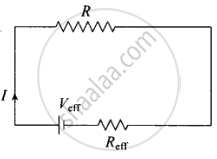
Now according to the question if all the resistances and the effective voltage are increased n-times, then we have
`V_("eff")^("new") = nV_("eff"), R_("eff")^("new") = nR_("eff")`
And Rnew = nR
Then, the new current is given by
`I^' = (nV_("eff"))/(nR_("eff") + nR) = (n(V_("eff")))/(n(R_("eff") + R)) = ((V_("eff")))/((R_("eff") + R)) = I`
The last result of two equations is same, so we can say that current remains the same.
APPEARS IN
संबंधित प्रश्न
Find the resistance of a conductor if 0.24 A current is passing through it and a potential difference of 24 V is applied across it.
Will current flow more easily through a thick wire or a thin wire of the same material, when connected to the same source? Why?
Why are coils of electric toasters and electric irons made of an alloy rather than a pure metal?
When a 12 V battery is connected across an unknown resistor, there is a current of 2.5 mA in the circuit. Find the value of the resistance of the resistor.
Keeping the p.d. constant, the resistance of a circuit is halved. The current will become:
(a) one-fourth
(b) four time
(c) half
(d) double
In a conductor 6.25 × `10^16` electrons flow from its end A to B in 2 s. Find the current flowing through the conductor (e = 1.6 × `10^-19` C)
A car bulb connected to a 12 volt battery draws 2 A current when glowing. What is the resistance of the filament of the bulb? Will the resistance be more same or less when the bulb is not glowing?
In an experiment of verification of Ohm’s law following observations are obtained.
|
Potential difference V (in volt) |
0.5 | 1.0 | 1.5 | 2.0 | 2.5 |
| current I (in ampere) | 0.2 | 0.4 | 0.6 | 0.8 | 1.0 |
Draw a V-I graph and use this graph to find:
- the potential difference V when the current I is 0.5 A,
- the current I when the potential difference V is 0.75 V,
- the resistance in a circuit.
What are non-ohmic conductors? Give one exmaple. Draw a current-voltage graph for a non-ohmic conductor.
Define Current density.
State microscopic form of Ohm’s law.
What is ohmic device?
Obtain the macroscopic form of Ohm’s law from its microscopic form and discuss its limitation.
The unit of specific resistance is ____________.
Assertion: The statement of Ohm’s law is K = IR.
Reason: V = IR is the equation which defines resistance.

Calculate the total resistance of the circuit and find the total current in the circuit.
Consider a current carrying wire (current I) in the shape of a circle. Note that as the current progresses along the wire, the direction of j (current density) changes in an exact manner, while the current I remain unaffected. The agent that is essentially responsible for is ______.
Let the resistance of an electrical device remain constant, while the potential difference across its two ends decreases to one fourth of its initial value. What change will occur in the current through it? State the law which helps us in solving the above stated question.
The mathematical form of Ohm's Law is:
If the voltage across a conductor is increased while its temperature remains unchanged, what happens to the current flowing through it?
