Advertisements
Advertisements
प्रश्न
Which of the following is an ohmic resistance?
पर्याय
LED
Junction diode
Filament of a bulb
Nichrome wire
Advertisements
उत्तर
Nichrome wire
Hint: Substances that obey Ohm's law are called Ohmic resistors.
APPEARS IN
संबंधित प्रश्न
When a 12 V battery is connected across an unknown resistor, there is a current of 2.5 mA in the circuit. Find the value of the resistance of the resistor.
What is an Ohmic resistor?
The unit of electrical resistance is:
(a) ampere
(b) volt
(c) coulomb
(d) ohm
What is the necessary condition for a conductor to obey Ohm’s law?
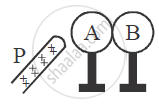
Two metallic spheres A and B kept on insulating stands are in contact with each other. A positively charged rod P is brought near the sphere A as shown in the figure. The two spheres are separated from each other, and the rod P is removed. What will be the nature of charges on spheres A and B?
State the relation correlating the electric current flowing in a conductor and the voltage applied across it. Also, draw a graph to show this relationship.
Answer the following question.
Distinguish between Ohmic and non-ohmic substances; explain with the help of example.
The ratio of the potential difference to the current is known as ________.
Which of the following is correct for V-I graph of a good conductor?
A heater of 220 V heats a volume of water m 5 mint time. A heater of 110 V heat in ten second. The resistance of the conductor is
