Advertisements
Advertisements
प्रश्न
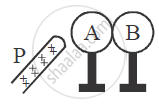
Two metallic spheres A and B kept on insulating stands are in contact with each other. A positively charged rod P is brought near the sphere A as shown in the figure. The two spheres are separated from each other, and the rod P is removed. What will be the nature of charges on spheres A and B?
Advertisements
उत्तर १
On sphere A there will be negative charge & one sphere B there will be positive charge

उत्तर २
When we bring a positively charged rod near the sphere A, The free electrons in the spheres are attracted to the rod. This leaves an excess of positive charge on the farther surface of sphere B. Now after separating the spheres and removing the rod, the charges on spheres rearrange themselves and get uniformly distributed over them, as shown in Figure given below.

संबंधित प्रश्न
An electrical bulb is marked 200V, 100W. Calculate the electrical resistance of its filament. If five such
bulbs are connected in series to a 200V supply, how much current will flow through them?
Name the law which is illustrated by the above V−I graph.
- Draw a V-I graph for a conductor obeying Ohm’s law.
- What does the slope of V–I graph for a conductor represent?
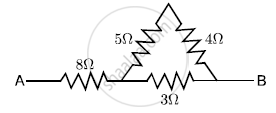
Calculate the effective resistance across AB?
What are ohmic conductors? Give one exmaple. Draw a graph showing the current-voltage relationship for an ohmic conductor.
State microscopic form of Ohm’s law.
What is ohmic device?
The unit of specific resistance is ____________.
A current of 0.8 A flows in a conductor of 40 Ω for 1 minute. The heat produced in the conductor will be ______.
Resistance (R) in a conductor is best described as:
