Advertisements
Advertisements
प्रश्न
State the limitations of Ohm’s law.
Advertisements
उत्तर
There are two main limitations:
(i) Temperature,
(ii) Physical condition of the conductor.
It is found that the ratio V/I is mo longer constant when the temperature is not kept constant. Generally, resistance increases with the rise in the temperature of the conductor.
Physical conditions of any conductor mainly include:
(i) Its length,
(ii) Its cross-sectional area,
(iii) The kind of material.
If there is no change in any of the above three conditions and also other condition like temperature remains constant, then Ohm’s law holds good, i.e., the ratio V/I remains constant.
संबंधित प्रश्न
When a 12 V battery is connected across an unknown resistor, there is a current of 2.5 mA in the circuit. Find the value of the resistance of the resistor.
Name the physical quantity whose unit is "ohm".
State Ohm’s law and draw a neat labelled circuit diagram containing a battery, a key, a voltmeter, an ammeter, a rheostat and an unknown resistance to verify it.
Draw a neat diagram for the verification of Ohm’s law by voltmeter-ammeter method. By another diagram show the relation between p.d. and current.
An ammeter placed in series with an electric radiator reads 0.5 amps and a voltmeter placed across it reads 230 volts. What is the resistance of the radiator?
Assertion: The statement of Ohm’s law is K = IR.
Reason: V = IR is the equation which defines resistance.
A student carries out an experiment and plots the V-I graph of three samples of nichrome wire with resistances R1, R2 and R3 respectively. Which of the following is true?

The circuit depicted in the figure is employed for studying Ohm’s Law. Instead of using a standard resistor, a student opts for a glass tube filled with mercury (tube 1), connected to the circuit through two electrodes, E1 and E2. He records the readings of the ammeter and voltmeter, thereby calculating the resistance. The student repeats the experiment by substituting tube 1 with tube 2, where the same amount of mercury fills tube 2.
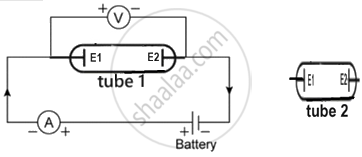
Neglecting internal resistance of the cell use (> or < or =) to compare:
- the resistance in both the cases.
- the voltmeter readings in both the cases.
- the specific resistance in both the cases.
The electric current between two joined conductors at different potentials continues to flow until:
If a current of 1 A flows through a conductor, then according to Ohm's Law, the resistance of the conductor is:
