Advertisements
Advertisements
प्रश्न
The resistance of a resistor is reduced to half of its initial value. If other parameters of the electrical circuit remain unaltered, the amount of heat produced in the resistor will become ______.
पर्याय
four times
two times
half
one forth
Advertisements
उत्तर
The resistance of a resistor is reduced to half of its initial value. If other parameters of the electrical circuit remain unaltered, the amount of heat produced in the resistor will become two times.
Explanation:
Joule’s Law of Heating:
`H = I^2Rt = V^2/R t`
If voltage V is constant, use: `H = V^2/Rt`
If current III is constant, use: H=I2Rt
`H = V^2/R t`
If R is reduced to `R/2`
`H_"new" = V^2/(R/2) t = V^2/R . 2t = 2 . H_"origional"`
2 . two times
APPEARS IN
संबंधित प्रश्न
The unit of electrical resistance is:
(a) ampere
(b) volt
(c) coulomb
(d) ohm
How would you connect two resistors in series? Draw a diagram. Calculate the total equivalent resistance.
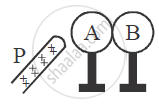
Two metallic spheres A and B kept on insulating stands are in contact with each other. A positively charged rod P is brought near the sphere A as shown in the figure. The two spheres are separated from each other, and the rod P is removed. What will be the nature of charges on spheres A and B?
State the relation correlating the electric current flowing in a conductor and the voltage applied across it. Also, draw a graph to show this relationship.
What are non-ohmic conductors? Give one exmaple. Draw a current-voltage graph for a non-ohmic conductor.
An ammeter placed in series with an electric radiator reads 0.5 amps and a voltmeter placed across it reads 230 volts. What is the resistance of the radiator?
Two cells each of 5V are connected in series across an 8Ω resistor and three parallel resistors of 4Ω, 6Ω, and 12Ω. Draw a circuit diagram for the above arrangement. Calculate
- the current drawn from the cell
- current through each resistor
What is the resistance of a conductor through which a current of 0.5 A flows when a potential difference of 2V is applied across its ends?
The electric current between two joined conductors at different potentials continues to flow until:
