Advertisements
Advertisements
प्रश्न
The resistance of a resistor is reduced to half of its initial value. If other parameters of the electrical circuit remain unaltered, the amount of heat produced in the resistor will become ______.
विकल्प
four times
two times
half
one forth
Advertisements
उत्तर
The resistance of a resistor is reduced to half of its initial value. If other parameters of the electrical circuit remain unaltered, the amount of heat produced in the resistor will become two times.
Explanation:
Joule’s Law of Heating:
`H = I^2Rt = V^2/R t`
If voltage V is constant, use: `H = V^2/Rt`
If current III is constant, use: H=I2Rt
`H = V^2/R t`
If R is reduced to `R/2`
`H_"new" = V^2/(R/2) t = V^2/R . 2t = 2 . H_"origional"`
2 . two times
APPEARS IN
संबंधित प्रश्न
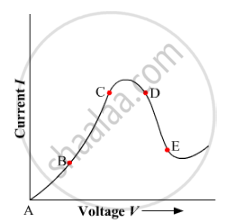
Graph showing the variation of current versus voltage for a material Ga As is shown in the figure. Identify the region of
(i) negative resistance
(ii) where Ohm's law is obeyed.
An electrical bulb is marked 200V, 100W. Calculate the electrical resistance of its filament. If five such
bulbs are connected in series to a 200V supply, how much current will flow through them?
Explain the equivalent resistance of a series resistor network.
Which of the following I-V graph represents ohmic conductors?
The variable resistance is called ____________.
Assertion: The statement of Ohm’s law is K = IR.
Reason: V = IR is the equation which defines resistance.

Calculate the total resistance of the circuit and find the total current in the circuit.
How is electric current related to the potential difference across the terminals of a conductor?
Draw a labelled circuit diagram to verify this relationship.
What is the nature of the graph obtained when potential difference is plotted against current for an Ohmic conductor?
