Advertisements
Advertisements
प्रश्न
How would you connect two resistors in series? Draw a diagram. Calculate the total equivalent resistance.
Advertisements
उत्तर
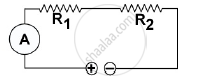
If current I is drawn from the battery, the current through each resistor will also be I.
On applying Ohm's law to the two resistors separately, we further
have
`"V"_1 = "I R"_1`
`"V"_2 = "I R"_2`
`"V" = "V"_1 + "V"_2`
`"IR" = "I R"_1+ "I R"_2`
`"IR" = "I " ["R"_1+ "R"_2]`
`"R" = "R"_1+ "R"_2`
Total Resistance in series R
`"R" = "R"_1+"R"_2+"R"_3`
APPEARS IN
संबंधित प्रश्न
What is Resistivity?
Write the SI unit of resistivity
The unit of electrical resistance is:
(a) ampere
(b) volt
(c) coulomb
(d) ohm
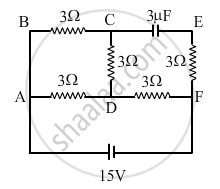
In the circuit shown in the figure, find the total resistance of the circuit and the current in the arm AD.
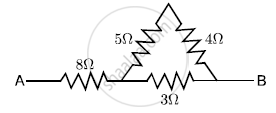
Calculate the effective resistance across AB?
State Ohm’s law.
A current of 2amp flowing through a conductor produced 80 joule of heat in 10 sec. The resistance of the conductor is:-
Two cells of same emf E but internal resistance r1 and r2 are connected in series to an external resistor R (Figure). What should be the value of R so that the potential difference across the terminals of the first cell becomes zero.
What is the resistance of a conductor through which a current of 0.5 A flows when a potential difference of 2V is applied across its ends?
You are provided with a resistor, a key, an ammeter, a voltmeter, four cells of 1.5 V each and few connecting wires. Using circuit components, draw a labelled circuit diagram to show the setup to study Ohm's law.
State the relationship between potential difference (V) across the resistor and the current (I) flowing through it. Also draw V-I graph, taking V on the X-axis.
