Advertisements
Advertisements
Question
How would you connect two resistors in series? Draw a diagram. Calculate the total equivalent resistance.
Advertisements
Solution
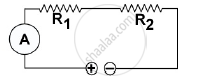
If current I is drawn from the battery, the current through each resistor will also be I.
On applying Ohm's law to the two resistors separately, we further
have
`"V"_1 = "I R"_1`
`"V"_2 = "I R"_2`
`"V" = "V"_1 + "V"_2`
`"IR" = "I R"_1+ "I R"_2`
`"IR" = "I " ["R"_1+ "R"_2]`
`"R" = "R"_1+ "R"_2`
Total Resistance in series R
`"R" = "R"_1+"R"_2+"R"_3`
APPEARS IN
RELATED QUESTIONS
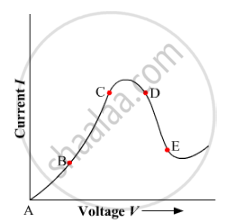
Graph showing the variation of current versus voltage for a material Ga As is shown in the figure. Identify the region of
(i) negative resistance
(ii) where Ohm's law is obeyed.
Name the unit of electrical resistance and give its symbol.
An electric bulb draws 1.2 A current at 6.0 V. Find the resistance of filament of bulb while glowing.
A wire of resistance 9 ohm having length 30 cm is tripled on itself. What is its new resistance?
State and define Ohm’s law.
Ohm’s law states the relationship between power and voltage.
A wire connected to a power supply of 230 V has power dissipation P1. Suppose the wire is cut into two equal pieces and connected parallel to the same power supply. In this case, power dissipation is P2. The ratio of `"P"_2/"P"_1` is
Define temperature coefficient of resistance.
A student carries out an experiment and plots the V-I graph of three samples of nichrome wire with resistances R1, R2 and R3 respectively. Which of the following is true?

State Ohm’s law? How can it be verified experimentally? Does it hold good under all conditions? Comment.
